
Investigating the Relationship Between Reviews, Local Search Position and Customer Engagement
Introduction
Hundreds of five-star reviews might suggest that a business has a strong online reputation.
But does a strong review profile necessarily translate into stronger search visibility?
And what happens when a business with substantially fewer reviews appears higher in local search results than a business with hundreds?
These questions formed the starting point for our second Visibility Investigation™.
We examined two anonymised businesses offering barcode printing-related products and solutions in the Mumbai metropolitan region. Both had five-star review profiles, but our initial observations showed a notable contrast between their reported Google local-pack positions and customer engagement assessments.
The purpose is not to declare either business successful or unsuccessful. It is to investigate what these differences may tell us—and what additional evidence we would need before drawing conclusions.
Business names and identifying details have been withheld for confidentiality. The observations below are based on a preliminary assessment, not a comprehensive search performance or conversion audit.
1. The Business Situation
For many businesses, online reviews have become an important part of how prospective customers assess credibility.
A substantial collection of positive reviews can help potential buyers feel more confident about making contact. Reviews may also contribute to prominence in Google’s local search results.
However, local search visibility involves more than reviews alone.
Google identifies three main factors in local rankings:
-
Relevance: How well a business profile matches what someone is searching for.
-
Distance: How far the business is from the searcher.
-
Prominence: How well-known the business is, with review counts and ratings among the contributing information.
Consequently, a strong review profile does not guarantee the highest position for every search.
This raises an important question:
When two businesses have positive review profiles but different reported local search positions, what else should we investigate?
2. The Initial Observation
Our preliminary comparison involved two businesses in the barcode printing-related market.
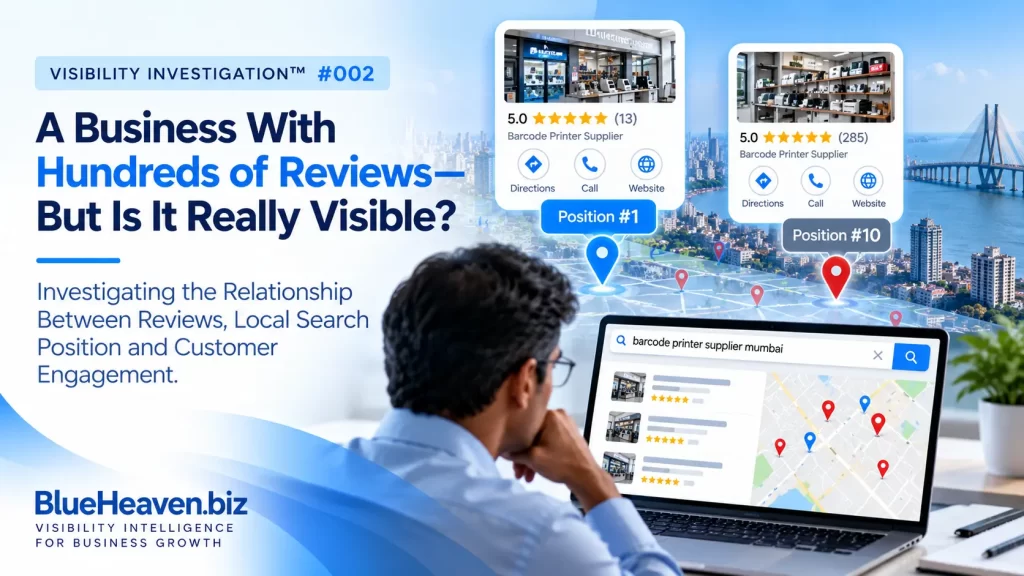
Business A: Fewer Reviews, Higher Reported Position
The first business had approximately a dozen five-star reviews, most of which appeared to be between one and five years old.
Its reported Google local-pack position was No. 1 for the selected product-and-location search phrase.
Its Google Business Profile optimisation was assessed as medium, and its customer engagement was also assessed as medium.
Business B: Hundreds of Reviews, Lower Reported Position
The second business had nearly 300 five-star reviews, including recent reviews.
Yet its reported Google local-pack position was No. 10 for the selected search phrase.
Its Google Business Profile optimisation was also assessed as medium, while its customer engagement was assessed as good.
The contrast
The initial observations can be summarised as follows:
| Signal | Business A | Business B |
|---|---|---|
| Reviews & Ratings | About a dozen five-star reviews; mostly older | Hundreds of five-star reviews, including recent ones |
| Reported local-pack position | No. 1 | No. 10 |
| Google Business Profile optimisation | Medium | Medium |
| Customer engagement assessment | Medium | Good |
| Behaviour signals | Further data required | Further data required |
These are preliminary observations, not a controlled comparison. The reported positions would need to be verified under consistent search conditions before they could be treated as directly comparable.
Nevertheless, the contrast gives us a useful question to investigate.
3. What Does This Comparison Tell Us?
At first glance, the business with hundreds of reviews might be expected to appear above the business with only a small number.
But that expectation assumes reviews are the dominant factor in the ranking.
Google’s published guidance does not support that assumption. Local rankings depend on relevance, distance and prominence, and Google does not disclose the exact weighting of individual signals.
Several questions therefore arise.
Is the search phrase equally relevant to both businesses?
The products, services, categories and information presented in each profile may influence how closely each business matches the search.
Were both businesses evaluated from the same location?
Local results can change depending on the searcher’s location. A reported position without a documented search location is incomplete evidence.
Were the positions recorded at the same time and under comparable conditions?
A ranking observation is only useful for comparison when the search phrase, location, device or search environment, and timing are sufficiently consistent.
What other prominence signals might be relevant?
Review counts are one part of the picture. Other publicly available information and the wider online presence may also deserve examination.
These are possible avenues of investigation—not confirmed explanations for the observed difference.
4. Reviews & Ratings: Reputation Is One Signal, Not the Whole Picture
Reviews can serve two important purposes.
First, they help prospective customers evaluate a business through the experiences shared by others.
Second, review counts and ratings can contribute to Google’s assessment of prominence.
However, three distinctions matter.
Review quantity is not the same as overall visibility.
A business can have hundreds of reviews and still appear lower for a particular search. That does not establish that its reviews are ineffective; other ranking considerations may be involved.
Review recency adds useful context.
Recent reviews can provide prospective customers with more current information about customer experiences.
But the presence of recent reviews does not, by itself, establish how strongly they influence a particular local ranking.
A five-star rating is not a complete measure of business performance.
Ratings reveal one aspect of customer feedback. They do not independently establish how easily a business is discovered, how relevant it appears for a specific search, how effectively visitors engage or how many enquiries become customers.
Reviews matter. But the business question is how reviews relate to the other signals that shape visibility and customer decisions.
5. Customer Engagement: Another Important Difference
Our preliminary assessment rated the first business’s customer engagement as medium and the second business’s as good.
That contrast is worth examining, but the assessments should not be mistaken for measured conversion performance.
Customer engagement can involve actions such as visiting a website, calling a business, requesting information or making an enquiry.
A deeper investigation would need to establish which actions are available, how often they occur and whether they lead to meaningful commercial opportunities.
For example, a business may have a strong review profile and an effective customer contact process but appear lower for one particular search phrase.
Another may appear prominently for that phrase but receive relatively little meaningful engagement.
Neither situation can be confirmed from review counts and reported rankings alone.
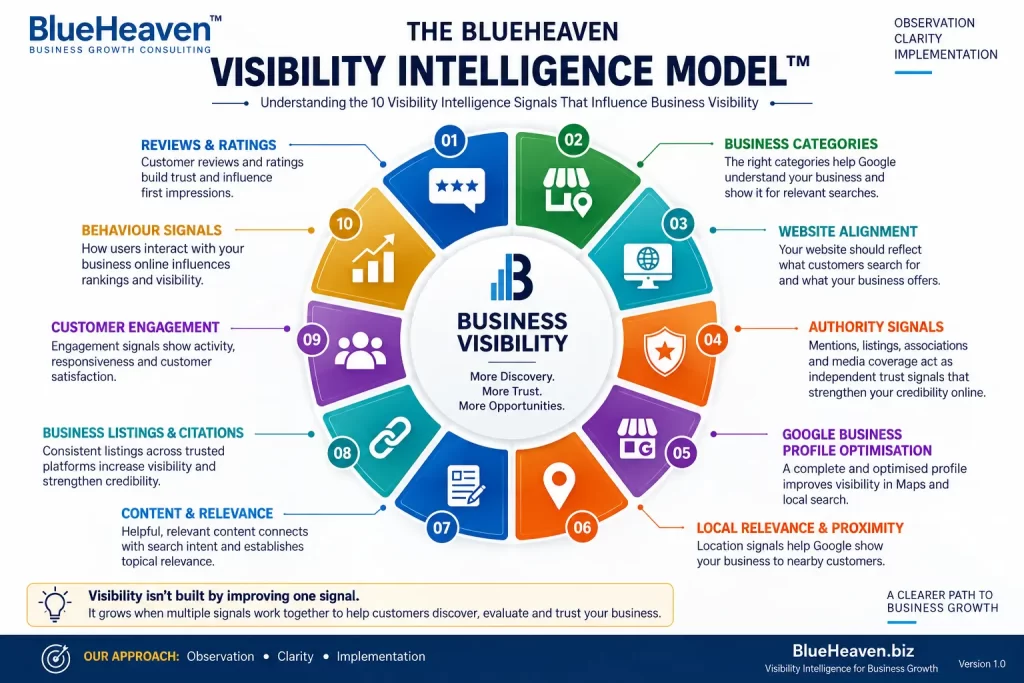
This is why Customer Engagement and Behaviour Signals are separate signals in the BlueHeaven Visibility Intelligence Model™.
Engagement concerns actions. Behaviour signals concern patterns in those actions.
Understanding either requires evidence beyond a single public-facing indicator.
6. What We Cannot Conclude Yet
A credible investigation must be clear about the limits of its evidence.
Based on the preliminary observations available, we cannot conclude:
-
That the business with hundreds of reviews has poor Google Business Profile optimisation.
-
That its review profile is failing to support its visibility.
-
That the business ranked first has stronger overall visibility.
-
That customer engagement assessments reflect actual enquiry or sales conversion rates.
-
That either business has a confirmed visibility problem.
We would need additional evidence to establish these points.
This could include repeatable local-search observations, a closer review of each business profile, relevant website content, search-performance data and actual engagement metrics where available.
The difference between an observation and a conclusion is central to this investigation.
7. What Should Be Investigated Next?
The initial comparison raises five practical questions.
1. Search relevance
How closely does each business’s profile and website match the selected search phrase and the buyer’s likely requirements?
2. Search location
How do the reported positions change when searches are conducted from consistent locations within the relevant market?
3. Profile and website alignment
Do the business categories, services, product information and website content communicate a consistent and relevant offering?
4. Reputation and prominence
Beyond review counts and ratings, what other publicly observable evidence may help explain how each business is discovered and evaluated?
5. Engagement and behaviour
What do website analytics, search-performance reports, calls, enquiries and other available records reveal about what happens after discovery?
These questions would help distinguish between a ranking difference, a broader visibility pattern and a potential commercial opportunity.
8. Consultant’s Observation
One of the common mistakes in marketing is to treat a single strong indicator as proof that the overall business situation is strong.
A large review count may be encouraging. A high local-pack position may also be encouraging. Neither tells the entire story.
The more useful question is how the signals relate to one another.
A business may have a strong reputation but appear inconsistently for relevant searches. Another may rank prominently for a particular phrase but need further investigation into the quality of the engagement it receives.
The point is not to diminish the value of reviews or rankings.
It is to avoid confusing one indicator with the complete picture.
Good consulting begins by asking what the evidence actually tells us—and what it does not.
9. The Visibility Intelligence Perspective
This investigation focuses on four signals from the BlueHeaven Visibility Intelligence Model™:
-
01. Reviews & Ratings — What does the public review profile communicate?
-
05. Google Business Profile Optimisation — How well does the business profile present and describe the offering?
-
09. Customer Engagement — What meaningful actions do customers take after discovering the business?
-
10. Behaviour Signals — What patterns emerge from those actions?
The four signals offer different perspectives.
Reviews and ratings contribute to the reputation picture. Business Profile information helps establish relevance and communicate the offering. Customer engagement concerns actions. Behaviour signals help examine patterns in those actions.
The key insight is not that one signal is more important in every situation.
It is that the relationship between signals may reveal questions that an individual metric cannot answer.
The objective is to determine which signals matter for the specific business situation and what evidence is needed to interpret them responsibly.
10. Key Takeaway
A business with hundreds of positive reviews may still appear below a business with far fewer reviews for a particular local search.
That contrast does not prove that reviews are unimportant or that the lower-ranked business has a visibility problem.
It tells us that review counts alone are insufficient to explain the result.
To understand what is happening, we must examine search relevance, location, profile and website alignment, other evidence of prominence, customer engagement and the patterns that emerge from actual data.
One signal gives us an observation. Connected signals help us ask better questions. Further evidence helps us determine what those observations mean.
The BlueHeaven Visibility Intelligence Model™
Ten connected signals. One broader picture of business visibility.
What Comes Next?
The next Visibility Investigation™ will examine another business situation to explore how connected visibility signals can reveal questions that individual metrics may miss.
About Visibility Investigations™
Visibility Investigations™ by BlueHeaven.biz examine publicly observable business visibility, identify patterns worth exploring and distinguish evidence from assumptions. They demonstrate a structured investigative approach without presuming that every business examined has a confirmed problem.
Want to Understand Your Business Visibility?
Every business has a different combination of customers, markets, competitive conditions and growth priorities.
A Visibility Snapshot™ offers a starting point for examining selected visibility signals, identifying notable observations and determining what may deserve closer investigation.
BlueHeaven.biz — Visibility Intelligence & Business Growth Consulting
Observation • Clarity • Implementation