
Understanding Behaviour Signals
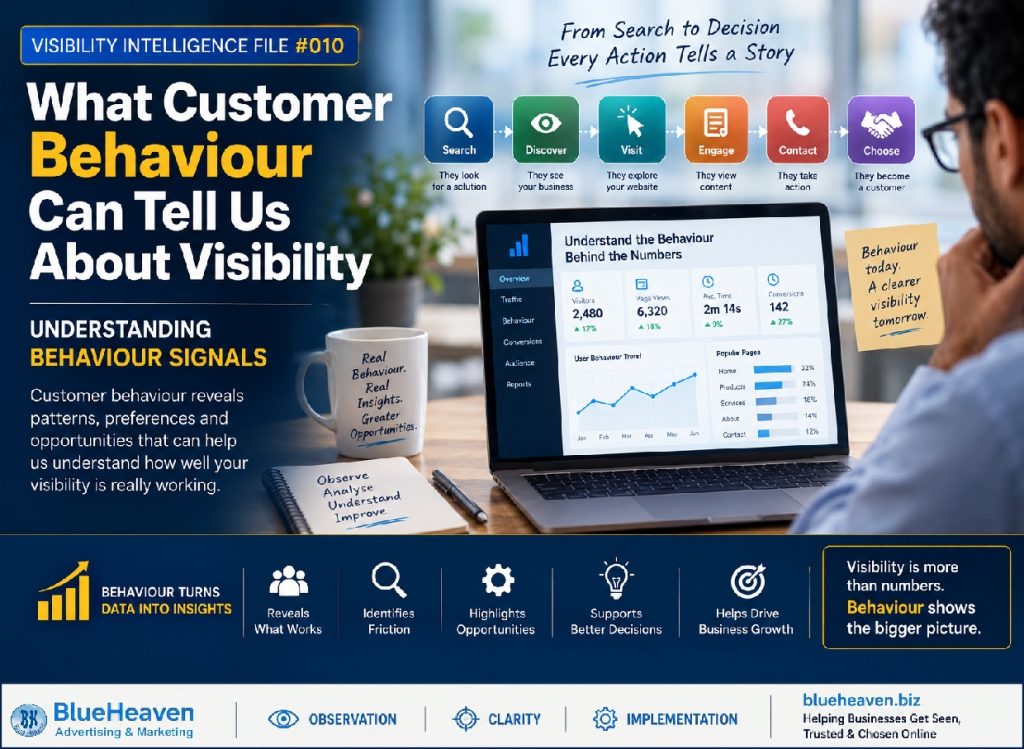
Introduction
A business can be visible.
Customers can find it.
They can engage with it.
But there is another question worth investigating:
What does the way customers behave tell us about the effectiveness of that visibility?
This is the focus of Behaviour Signals, the tenth and final signal in the BlueHeaven Visibility Intelligence Model™.
Behaviour is different from visibility.
It is different from engagement too.
A customer may click, call, visit or enquire. Those are engagement actions.
But when we look at patterns across many such actions, we can begin to ask deeper questions:
- What are customers repeatedly doing?
- Where are they dropping off?
- What information are they seeking?
- Which pages attract attention?
- Which channels generate meaningful responses?
- Do people return?
- Are customers moving from discovery to evaluation and action?
- Where does the customer journey appear to weaken?
These patterns can reveal things that a simple visibility report may not show.
Visibility Intelligence Files
Visibility Intelligence Files are a series of business investigations exploring the ten Visibility Intelligence Signals that influence how customers discover, evaluate and choose businesses.
With File #010, we complete the ten-signal investigation.
The Investigation
Consider two businesses that both appear prominently when customers search for their products or services.
Both receive visibility.
Both receive website visits.
Both receive enquiries.
On the surface, they may appear equally successful.
But look more closely.
Business A
Customers:
Discover → Visit → Leave
Business B
Customers:
Discover → Explore → Return → Enquire → Engage
The difference is not necessarily how visible the businesses are.
The difference may be found in customer behaviour after visibility occurs.
That makes behaviour worth investigating.
What Are Behaviour Signals?
Behaviour Signals are patterns in how users interact with a business’s digital presence and how those interactions develop over time.
Depending on the business and available data, these patterns might include:
- Search-to-website behaviour
- Pages visited
- Time and depth of exploration
- Repeat visits
- Click patterns
- Calls or enquiries following discovery
- Movement between product or service pages
- Return visits before enquiry
- Actions taken after viewing reviews
- Navigation patterns
- Drop-off points
- Differences between traffic sources
- Engagement patterns across devices or channels
The important word is patterns.
One isolated click tells us very little.
Repeated behaviour can tell us much more.
Behaviour Is Not the Same as Engagement
This distinction is important because File #009 and File #010 should not become repetitive.
Customer Engagement asks:
What meaningful actions are customers taking?
Behaviour Signals asks:
What patterns in those actions can tell us about the visibility and customer journey?
For example:
A customer visits a product page.
That is an engagement action.
But if we discover that:
70% of visitors who arrive through a particular search repeatedly visit the same product page before submitting an enquiry,
we have identified a behaviour pattern.
That pattern may provide a useful business insight.
From Individual Actions to Patterns
Imagine a business receives 100 website visitors.
Looking only at total visitors tells us very little.
But suppose we discover:
100 visitors
↓
62 visit the Products page
↓
41 visit one particular product
↓
27 visit the Technical Specifications page
↓
15 return within seven days
↓
8 submit an enquiry
Now we have something much more valuable than a visitor count.
We have a picture of how prospects behave.
That can lead to better questions.
Why is the technical specification page receiving so much attention?
Are visitors finding enough information there?
Would a stronger call-to-action help?
Are those returning visitors more likely to enquire?
Behaviour doesn’t automatically provide the answer.
It helps us identify where to investigate.
The Behavioural Trail
Customers rarely move through a perfectly straight digital journey.
A typical journey might look like:
Search
↓
Business Profile
↓
Website
↓
Product Page
↓
Leave
↓
Return through Search
↓
Read Reviews
↓
Return to Website
↓
Contact
This is important.
A customer may not enquire during the first visit.
They may need time to evaluate.
They may compare alternatives.
They may return several times before taking action.
Therefore, judging visibility only by the immediate response to the first visit can be misleading.
Behaviour Can Reveal Friction
One of the most useful applications of behavioural analysis is identifying friction.
Suppose many people:
Landing Page → Product Page → Contact Page → Leave
That could be a sign worth investigating.
Perhaps:
- The contact process is unclear.
- The customer needs information that isn’t available.
- The call-to-action is weak.
- Pricing information is missing where appropriate.
- The business isn’t answering an important question.
- The visitor isn’t yet convinced.
We should not automatically conclude that one of these is the cause.
Instead:
Behaviour identifies the point that deserves investigation.
That is the consulting value.
Behaviour Can Also Reveal What Works
Behaviour analysis shouldn’t be limited to finding problems.
It can identify strengths.
Suppose visitors who read customer reviews are substantially more likely to proceed to the website.
That suggests reviews may be helping customers move from:
Discovery → Evaluation
Or suppose visitors who view a particular case study are more likely to make an enquiry.
That suggests the case study may be helping:
Evaluation → Trust → Action
The lesson is not necessarily:
“Create more case studies.”
It is:
Understand what information appears to help customers progress.
The Importance of Search Intent
Behaviour becomes particularly interesting when connected to search intent.
Consider three searches:
“industrial pumps manufacturer”
“industrial pumps price”
“industrial pumps supplier near me”
These may represent different stages of the buying process.
If visitors arriving from one type of search behave differently from visitors arriving from another, that difference can provide useful insight.
For example:
One group may immediately examine products.
Another may spend more time reading technical information.
Another may look for contact details.
This can help a business understand whether its digital presence is aligned with the questions customers are actually trying to answer.
Not All Traffic Is Equal
A common mistake is to celebrate traffic volume without examining its quality.
Imagine:
Source A
5,000 visitors
20 enquiries
Source B
500 visitors
35 enquiries
Source A produced more traffic.
Source B produced more meaningful business activity.
This is why behavioural analysis should be connected to business objectives.
Traffic is not the same as opportunity.
And opportunity is not the same as revenue.
The objective is to understand the journey between them.
Behaviour Across Different Businesses
Behaviour Signals will look different depending on the business model.
Local Service Business
A useful pattern may be:
Search → Profile → Call → Appointment
Professional Consultant
Search → Website → About → Insights → Enquiry
Machinery Manufacturer
Search → Product → Specifications → Application → Enquiry
B2B Supplier
Search → Product Category → Product Details → Company Information → Contact
E-commerce Business
Search → Product → Product Comparison → Cart → Purchase
There is no universal behavioural pattern.
The correct question is:
What behaviour should we reasonably expect from customers for this particular business?
The Behaviour Gap
I use the term Behaviour Gap to describe the difference between:
What customers appear to want to do
and
What the digital presence enables or encourages them to do.
For example:
Customers appear interested in a product.
They repeatedly visit the product page.
But very few proceed to enquiry.
That is a Behaviour Gap worth investigating.
Likewise:
Customers frequently search for a service.
They visit the website.
But they don’t find a clear path to contact the business.
Again, there may be a gap.
The answer isn’t always to increase visibility.
Sometimes the answer is to improve what happens after visibility.
Behaviour Can Connect the Ten Signals
This is where the tenth signal becomes especially important.
The ten Visibility Intelligence Signals should not be viewed as ten isolated optimisation tasks.
They interact.
For example:
Reviews & Ratings
may influence trust.
↓
Business Categories
may influence discovery relevance.
↓
Website Alignment
may help answer the customer’s search intent.
↓
Authority Signals
may strengthen credibility.
↓
Google Business Profile Optimisation
may improve the business’s discovery experience.
↓
Local Relevance & Proximity
may connect the business with nearby searches.
↓
Content & Relevance
may help customers evaluate.
↓
Business Listings & Citations
may reinforce the business’s external presence.
↓
Customer Engagement
may produce meaningful actions.
↓
Behaviour Signals
may help us understand what happens across that journey.
This is why the model is an intelligence model, rather than simply an optimisation checklist.
Behaviour Is a Diagnostic Signal
This is perhaps the most important idea in File #010.
Behaviour should not be treated simply as:
“Something we need to manipulate.”
Instead, it can be treated as:
Evidence that helps us understand how the visibility ecosystem is performing.
If customers repeatedly behave in a certain way, we can ask:
Why?
If they stop at a particular point:
Why?
If they return repeatedly:
What are they looking for?
If they move from reviews to website:
What role might trust be playing?
If they visit a particular service page before enquiring:
What does that tell us about their decision process?
These questions turn raw data into business intelligence.
Beware of Over-Interpreting Behaviour
There is an important caution.
A behavioural pattern is an observation, not automatically an explanation.
For example:
“Visitors leave the website after 20 seconds.”
That does not prove the website is poor.
Perhaps they found exactly what they needed.
Likewise:
“Visitors spend five minutes on a page.”
That doesn’t necessarily mean the page is effective.
They may have struggled to find information.
Therefore:
Behaviour tells us what happened.
It does not automatically tell us why it happened.
The next step is investigation.
This is consistent with the BlueHeaven approach:
Observation → Clarity → Implementation
What Should Businesses Investigate?
A useful Behaviour Signals investigation could ask:
Discovery
Where did visitors come from?
Exploration
What did they look at?
Progression
What did they do next?
Friction
Where did they stop?
Return
Did they come back?
Conversion
Did behaviour eventually lead to an enquiry, appointment, purchase or another meaningful action?
Quality
Were these interactions relevant to the business?
These questions are usually more valuable than simply asking:
“How many people visited?”
The Consultant’s Perspective
When I look at visibility, I don’t want to stop at:
“You are appearing.”
I also don’t want to stop at:
“People are clicking.”
I want to understand:
“What are people doing—and what can that behaviour tell us?”
That may reveal:
- A missed opportunity
- A strong customer pathway
- A trust problem
- An information gap
- A content opportunity
- A conversion barrier
- A valuable customer segment
- An overlooked product or service
- Or simply an assumption about the customer journey that isn’t supported by actual behaviour
That’s where visibility becomes intelligence.
A Better Question to Ask
Instead of asking:
How much traffic are we getting?
ask:
What are the right customers doing after they discover us?
Instead of asking:
Which page gets the most visitors?
ask:
Which pages help customers move toward meaningful action?
Instead of asking:
Why aren’t we getting more enquiries?
ask:
Where does the customer journey appear to lose momentum?
Better questions produce better investigations.
Visibility Intelligence Perspective
Behaviour Signals is Signal #10 in the BlueHeaven Visibility Intelligence Model™.
It completes the ten-signal framework.
But it is not the “final optimisation.”
It is a lens through which we can examine the interaction of the entire visibility ecosystem.
The model begins with signals that help customers discover a business.
Then it considers signals that help them:
Evaluate
Trust
Engage
And finally, behaviour can help us understand what is happening across that journey.
The Ten Signals Work Together
The model can therefore be viewed as a connected system:
01 — Reviews & Ratings
02 — Business Categories
03 — Website Alignment
04 — Authority Signals
05 — Google Business Profile Optimisation
06 — Local Relevance & Proximity
07 — Content Relevance
08 — Business Listings & Citations
09 — Customer Engagement
10 — Behaviour Signals
No single signal guarantees visibility.
No single signal guarantees growth.
The objective is to understand how multiple signals interact within the customer’s decision journey.
Key Takeaway
Customer behaviour is evidence.
It can show us where customers are finding value, where they encounter friction and how they move—or fail to move—from discovery toward action.
But behaviour should be interpreted carefully.
A click is not automatically intent.
A visit is not automatically interest.
Time spent is not automatically engagement.
And traffic is not automatically opportunity.
The value lies in the pattern.
When behaviour is examined alongside search intent, engagement, business objectives and the other Visibility Intelligence Signals, it can reveal where further investigation is worthwhile.
Conclusion
Visibility is often measured as though it were a destination.
Rankings.
Impressions.
Views.
Traffic.
But customers don’t experience visibility as a number.
They experience it as a journey.
They search.
They discover.
They compare.
They explore.
They return.
They evaluate.
They engage.
They decide.
Every one of those actions can provide clues.
The role of Behaviour Signals is not to chase or manipulate every customer action.
It is to observe the patterns and ask better questions.
Because when we understand how the right customers behave after discovering a business, we gain a clearer picture of what its visibility is actually accomplishing.
Visibility becomes intelligence when we don’t just measure who found us—but understand what happened after they did.
Investigation Summary
| Investigation | Behaviour Signals |
|---|---|
| Question Investigated | What can customer behaviour reveal about the effectiveness of business visibility? |
| Key Observation | Individual actions provide limited information; patterns of behaviour can reveal strengths, friction and opportunities for further investigation. |
| Primary Learning | Behaviour should be treated as diagnostic evidence rather than a metric to manipulate. |
| Current Visibility Intelligence Signal | #10 — Behaviour Signals |
| What to Examine | Discovery paths, exploration, repeat visits, progression, drop-offs, meaningful actions and behavioural patterns relevant to the business. |
| Important Caution | Behaviour tells us what happened; it does not automatically explain why. |
| Series Status | Final investigation in the ten-signal framework |
The BlueHeaven Visibility Intelligence Model™
The BlueHeaven Visibility Intelligence Model™ provides a structured framework for understanding the ten Visibility Intelligence Signals that influence how customers discover, evaluate, trust and engage with businesses.
Current Visibility Intelligence Signal
#10 — Behaviour Signals
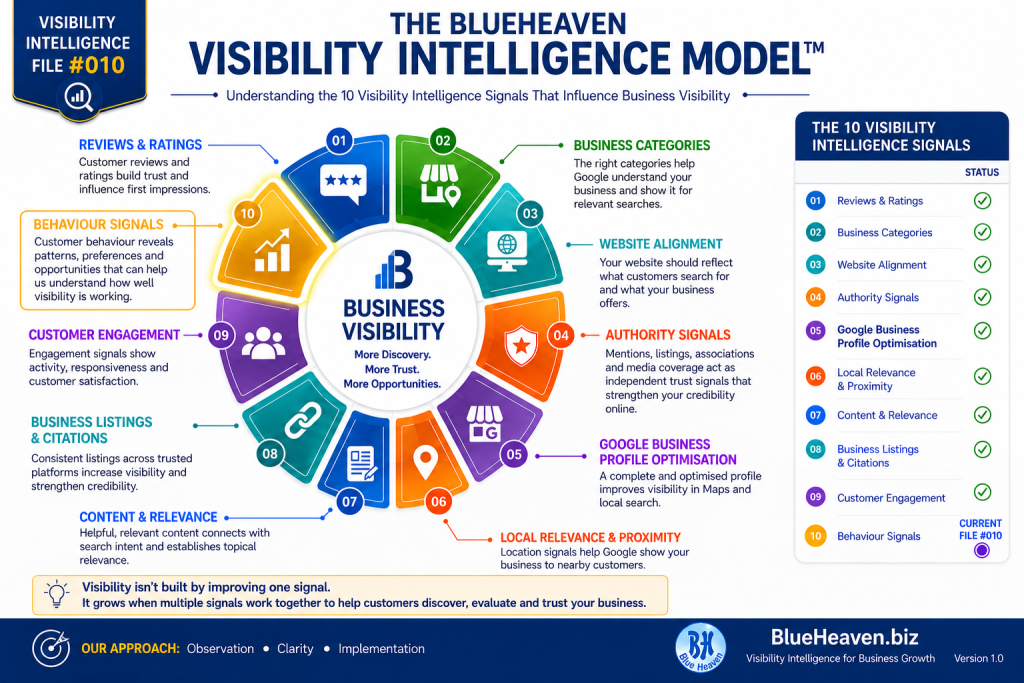
Visibility isn’t built by improving one signal. It grows when multiple signals work together to help customers discover, evaluate and trust your business.
 Browse All Visibility Intelligence Files
The Visibility Intelligence Series
10 Signals. One Visibility Picture.
With Visibility Intelligence File #010, we complete our investigation of the 10 Visibility Intelligence Signals that influence how customers discover, evaluate, trust and engage with a business online.
The ten signals are not isolated optimisation tasks. Together, they provide a structured way to examine the broader Business Visibility of a business.
The objective is not to optimise everything. It is to understand what matters, what is missing, and what deserves attention first.
The investigation ends here. The business diagnosis begins.
Every business has a different visibility situation. Some are easy to discover but difficult to evaluate. Some have strong credibility but weak engagement. Others may already possess valuable visibility assets that are simply underused.
That is why improving visibility should begin with Observation, Clarity and Implementation—not with a generic checklist of marketing activities.
Want to understand where your business stands?
#VisibilityIntelligence #BusinessVisibility #CustomerBehaviour #BusinessGrowth #MarketingStrategy #BehaviourSignals