
A Practical Framework for Understanding Business Visibility
Introduction
Businesses often think about visibility in terms of search rankings, website traffic, social media presence, reviews, advertising exposure, or how easily they appear in search results.
Each of these can tell us something.
But none of them, by itself, tells the complete story.
A business may appear prominently in search results but fail to communicate clearly what it offers.
It may have an excellent website but lack the authority or credibility that helps potential customers trust it.
It may have strong reviews but still be difficult to discover for relevant searches.
It may attract visitors but fail to turn that attention into meaningful engagement or business opportunities.
This raises a broader question:
How effectively is the business being discovered, understood, trusted and engaged with?
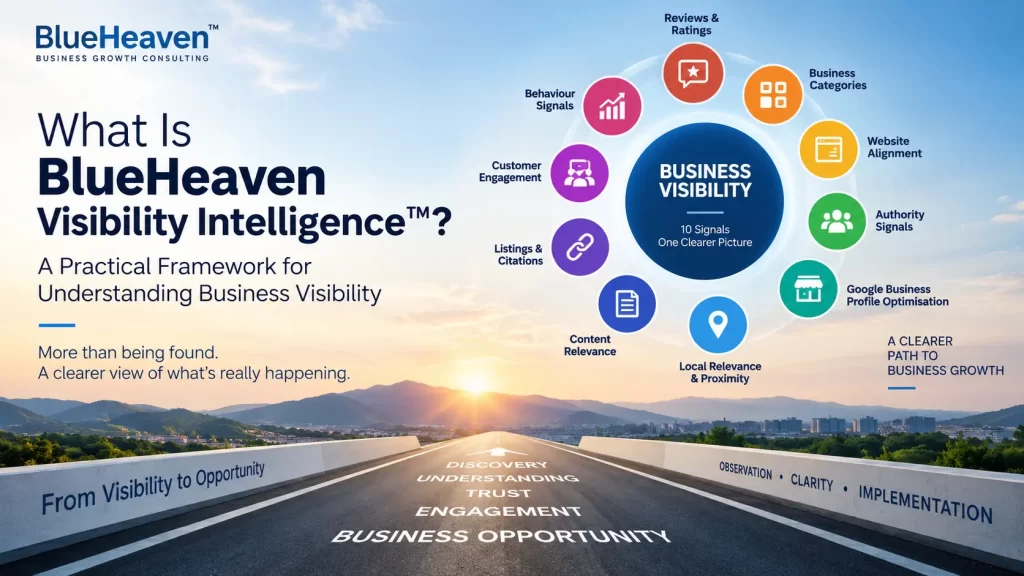
This is the question behind BlueHeaven Visibility Intelligence™.
What Is Visibility Intelligence™?
Visibility Intelligence™ is a structured approach to investigating how effectively a business is being discovered, understood, trusted, and engaged with online—and what observable patterns may reveal about opportunities and areas that deserve further investigation.
The emphasis is on investigation.
Visibility Intelligence is not simply about doing more marketing.
It begins with observation.
Instead of immediately asking:
“What should we optimise?”
the first question becomes:
“What is actually happening?”
From there, relevant signals can be examined, patterns identified and their potential business implications considered.
Only after understanding the situation should decisions about priorities and implementation be made.
Why Business Visibility Is More Than Being Found
Being found is important.
But being found is only the beginning.
Consider what can happen after a potential customer discovers a business.
They may ask:
-
What does this business actually offer?
-
Is it relevant to what I need?
-
Does the business appear credible?
-
Can I trust it?
-
What do other customers say?
-
Can I understand the offering quickly?
-
What should I do next?
-
Is there an easy way to contact or engage with the business?
This means business visibility extends beyond simple discovery.
A useful way to look at the broader journey is:
Discovery → Understanding → Trust → Engagement → Behaviour
These stages are connected, but they are not identical.
A business can perform well at one stage and have a weakness at another.
For example:
Easy to discover does not necessarily mean easy to understand.
Easy to understand does not necessarily mean easy to trust.
Easy to trust does not necessarily mean easy to engage with.
And what customers do after discovering a business can provide additional clues about what is working—and where friction may exist.
The 10 Visibility Intelligence Signals
The BlueHeaven Visibility Intelligence Model™ brings together ten signals that can provide different perspectives on business visibility.
They are:
01. Reviews & Ratings
Reviews and ratings can influence trust, credibility, and first impressions.
They provide potential customers with evidence of other people’s experiences and can form an important part of the evaluation process.
The investigation is not simply about the number of reviews.
It can also involve questions such as:
-
Are reviews recent?
-
Are they relevant?
-
Does the business respond?
-
What themes appear repeatedly?
-
Does the overall review profile support the business’s positioning?
02. Business Categories
Business categories help platforms understand what a business is and what kinds of searches it may be relevant to.
The right category structure can help communicate business identity more clearly.
The investigation may therefore consider whether the selected categories accurately represent the business, its primary offering and the markets it serves.
03. Website Alignment
A website should reflect what the business actually offers and what potential customers are looking for.
Website alignment involves more than having a website online.
Questions can include:
-
Does the website clearly communicate the business offering?
-
Can visitors quickly understand what the company does?
-
Does the terminology reflect customer needs?
-
Are important products or services easy to find?
-
Is the website aligned with the business’s actual market positioning?
A technically functioning website can still have an alignment gap.
04. Authority Signals
Businesses do not operate in isolation.
Mentions, industry associations, publications, media coverage, recognised relationships and other external references can contribute to how a business is perceived.
Authority Signals help us consider the external evidence surrounding a business.
The question is not simply:
“How many links or mentions does the business have?”
A more useful question is:
“What independent signals support the business’s credibility and expertise?”
05. Google Business Profile Optimisation
For businesses where local or location-based discovery matters, the Google Business Profile can play an important role in how the business is represented in Google’s ecosystem.
The investigation may consider whether the profile is complete, accurate, relevant and aligned with the business.
But again, the objective is not simply to tick optimisation boxes.
The broader question is:
Does the business’s Google presence accurately and effectively represent the business to potential customers?
06. Local Relevance & Proximity
For many businesses, particularly those serving defined geographic markets, location can influence discovery.
Local Relevance & Proximity considers how effectively a business is connected with the geographic areas and customers it intends to serve.
The significance of this signal varies considerably between businesses.
A neighbourhood service provider and an international B2B manufacturer, for example, may have very different geographic visibility considerations.
That is why the signals should not be treated as equally important for every business.
07. Content Relevance
More content does not automatically create better visibility.
Useful content should have a relationship with:
-
customer questions
-
search intent
-
business expertise
-
products or services
-
the markets the business serves
The investigation therefore goes beyond content volume.
The more useful question is:
Does the content help the right audience understand the business and its relevance to their needs?
08. Listings & Citations
A business may appear across directories, industry platforms, business databases and other external sources.
But being listed everywhere does not necessarily mean being visible where it matters.
Listings & Citations can be examined for dimensions such as:
-
Accuracy
-
Consistency
-
Relevance
-
Authority
-
Completeness
The objective is not simply to maximise the number of listings.
It is to understand whether the external business information supports accurate and credible discovery.
09. Customer Engagement
Visibility does not end when someone discovers a business.
A potential customer may:
-
visit the website
-
make a phone call
-
send an enquiry
-
request information
-
book an appointment
-
interact with a business profile
-
take another meaningful action
Customer Engagement looks at what happens after discovery.
Different businesses will naturally have different meaningful engagement actions.
The important question is:
Is visibility creating opportunities for meaningful interaction?
10. Behaviour Signals
Customer Engagement focuses on actions.
Behaviour Signals look more closely at patterns.
For example, individual actions may tell us that someone visited a website.
Patterns can tell us something more:
-
Where visitors tend to enter
-
What they look at
-
Where they leave
-
What they return to
-
Which pages appear to attract attention
-
Whether particular journeys repeatedly lead to engagement—or abandonment
Behaviour can therefore provide clues about what happens after discovery.
But behaviour must be interpreted carefully.
It can tell us what happened.
It does not always tell us why it happened.
That is where observation needs to be followed by investigation and interpretation.
How the Signals Work Together
The real value of the model does not come from looking at ten isolated items.
It comes from considering how the signals may interact.
For example, imagine a business with:
-
strong customer reviews
-
an established reputation
-
a large product range
-
a functioning website
At first glance, the business may appear to have strong visibility.
But further investigation could reveal that individual products are difficult to discover on the website.
That could create a disconnect between:
What the business has
and
What potential customers can easily discover.
Another business may have excellent content but weak external authority signals.
Another may have strong local visibility but limited engagement.
Another may generate significant website traffic but relatively few enquiries.
Each situation requires a different investigation.
This is why the ten signals should not be treated as ten independent optimisation projects.
They are different perspectives on one broader visibility picture.
Visibility Intelligence Is Not a Checklist
This distinction is central to the BlueHeaven approach.
The objective is not to take the ten signals and attempt to optimise all of them simultaneously.
Every business is different.
A local service business, a pharmaceutical manufacturer, a machinery manufacturer, a professional firm and an e-commerce business may have very different visibility priorities.
Their customers may behave differently.
Their buying journeys may be different.
Their geographic markets may be different.
Their sales cycles may be different.
Their competitive environments may be different.
Therefore, the relevance and importance of individual signals can vary.
The better question is:
Which signals matter most for this particular business, and what do they reveal when considered together?
That is the diagnostic role of Visibility Intelligence™.
What Visibility Intelligence™ Is Not
It is equally important to understand what the framework is not.
It is not a generic SEO checklist.
SEO may be relevant to a business’s visibility, but Visibility Intelligence looks beyond SEO alone.
It is not a list of Google ranking factors.
The ten signals are not presented as a formula for achieving a particular search position.
It is not a promise of higher rankings.
Visibility Intelligence is designed to investigate and understand—not guarantee a particular outcome.
It is not a collection of vanity metrics.
Traffic, impressions, followers or other numbers can be useful, but numbers without context do not necessarily explain the business situation.
It is not a requirement to optimise everything.
The purpose is to identify what deserves attention first.
It is not a substitute for business judgement.
Data and observable signals can inform decisions. They do not eliminate the need for experience, context and commercial judgement.
From Visibility to Business Opportunity
Why does all this matter to business growth?
Because visibility is not valuable simply because a business appears somewhere online.
Its value lies in what that visibility can potentially enable.
A customer may:
Discover the business.
Then:
Understand its offering.
Then:
Evaluate it.
Then:
Trust it.
Then:
Engage with it.
And the resulting behaviour may reveal opportunities—or friction.
This creates an important distinction.
Visibility is not the destination.
It is part of the path toward business opportunity.
For some businesses, a visibility gap may be the primary constraint.
For others, visibility may be adequate, while the bigger issue may lie in:
-
positioning
-
differentiation
-
enquiry handling
-
conversion
-
follow-up
-
customer experience
-
sales processes
-
market development
-
underused business assets
-
or other factors affecting growth
That is why Visibility Intelligence™ sits naturally within a broader Business Growth Consulting approach.
The objective is not to recommend more marketing simply because marketing is available.
The objective is to understand what is actually happening and what deserves attention.
The BlueHeaven Visibility Intelligence Approach™
The framework is supported by a simple consulting approach:
Observation → Clarity → Implementation
But the path to implementation requires investigation.
A more detailed working process is:
Observe → Investigate → Understand → Prioritise → Implement → Measure
Observe what is happening.
Investigate the relevant signals and evidence.
Understand the patterns and their possible implications.
Prioritise what appears to deserve attention first.
Implement appropriate actions.
Measure what happens afterwards.
This sequence is important because implementation without understanding can lead to wasted effort.
A business does not necessarily need more marketing.
It may first need more clarity.
The BlueHeaven Visibility Intelligence Model™
The ten signals form the BlueHeaven Visibility Intelligence Model™.
They provide a structured way to examine different dimensions of business visibility.
10 Signals. One Visibility Picture.
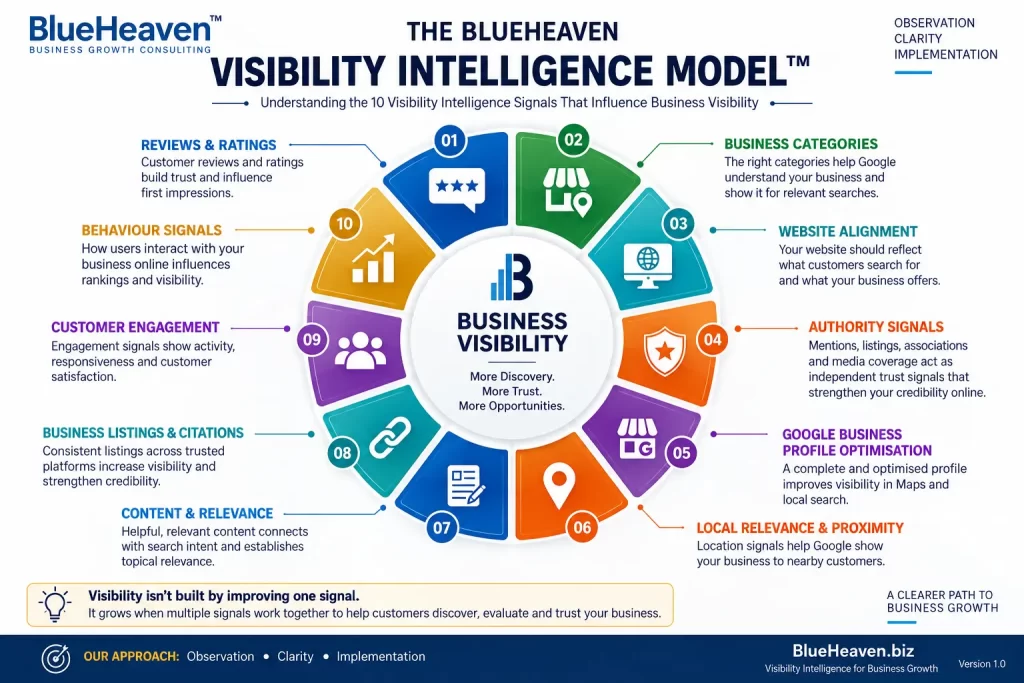
The model is not intended to suggest that every signal has the same importance in every business.
Instead, it provides a common framework through which relevant signals can be selected, examined and connected.
The ultimate objective is to understand the broader Business Visibility of the business.
The Bigger Picture
The ten signals can be viewed as different lenses through which business visibility can be investigated.
The broader customer journey can be expressed as:
Discovery → Understanding → Trust → Engagement → Behaviour
And behind the investigation is a simple consulting philosophy:
Don’t start with “What marketing should we do?”
Start with:
“What is actually happening?”
That change in perspective can lead to very different questions—and potentially very different business decisions.
Key Takeaway
Business visibility is not one metric, one channel or one optimisation task.
The BlueHeaven Visibility Intelligence Model™ brings together ten signals that provide different perspectives on how effectively a business is being discovered, understood, trusted and engaged with online.
The purpose is not to optimise everything.
It is to investigate what matters, understand how the signals interact, identify patterns and determine what deserves attention first.
Because ultimately:
Better visibility is not about being seen everywhere. It is about being discoverable, understandable, credible and relevant where it matters—and understanding what happens after customers find you.
Beyond the 10 Signals
The ten Visibility Intelligence Files examined each signal individually.
The next step is to look at them together.
In the coming articles, we will explore how different signals can interact, where gaps may appear, and what those patterns can reveal about a business.
This moves Visibility Intelligence™ from a framework for understanding signals toward a methodology for investigating businesses.
From signals to situations.
From observations to insights.
From visibility to opportunity.
Want to Understand Where Your Business Stands?
Every business has a different visibility situation.
The question is not simply whether your business is visible.
It is:
How effectively is your business being discovered, understood, trusted and engaged with—and where might there be opportunities worth investigating?
A Visibility Snapshot™ provides a concise diagnostic view of selected aspects of your business visibility, highlighting observations, potential gaps and areas that may deserve further investigation.
Request a Visibility Snapshot
Observation • Clarity • Implementation
Explore the Visibility Intelligence Series
 Browse All Visibility Intelligence Files
What Comes Next?
Putting the 10 Signals Together to Understand Business Visibility
In the next part of Beyond the 10 Signals, we will look at how the ten signals interact—and why a strong individual signal does not necessarily mean strong overall visibility.
#VisibilityIntelligence #BusinessVisibility #BusinessGrowth #MarketingStrategy #DigitalVisibility