
An Established Machinery Manufacturer—But How Easily Can Buyers Discover Its Solutions?
Investigating the Relationship Between Product Range, Website Clarity and Business Visibility

Introduction
A manufacturing business may have decades of experience, a diverse product portfolio and established customer relationships. But how effectively does its online presence communicate that value to potential buyers?
This is an important question in industrial markets, where purchasing decisions often involve technical specifications, application suitability, reliability and considerable evaluation before an enquiry is made.
In this first Visibility Investigation™, we examine the publicly observable online presence of an anonymised industrial machinery manufacturer.
The purpose is not to rate the business or assume that it has a visibility problem. It is to demonstrate how publicly available information can be examined through the BlueHeaven Visibility Intelligence Model™ to identify patterns, opportunities and questions worthy of further investigation.
The business name and identifying details have been withheld for confidentiality. This preliminary investigation is based on publicly observable information and does not include internal analytics, search-performance data or enquiry records.
1. The Business Situation
The business examined in this investigation is an established manufacturer of industrial machinery and equipment serving multiple product categories and industrial applications.
Its online presence communicates a broad portfolio of solutions, manufacturing experience and capabilities. The website also presents credibility-related information, such as customer testimonials, project-related content and manufacturing imagery.
These elements can help communicate a manufacturer’s experience and capabilities.
However, they raise a broader question:
How easily can a prospective buyer identify the right solution, understand its relevance and take the next step?
2. Our Initial Observation
The first observation is the breadth of the business’s offering.
A diverse portfolio can be a commercial strength. It enables a manufacturer to serve different customer requirements and operate across multiple applications.
However, different buyers have different needs. A buyer searching for a specific machine may have different questions from someone evaluating a complete system or investigating a solution for a particular industrial application.
Each buyer needs to recognise quickly:
-
Whether the manufacturer serves their industry and application.
-
Which products or systems are relevant to their requirements.
-
What distinguishes the available solutions.
-
What information they need before contacting the supplier.
The issue is not whether a business offers many products. It is whether its online presence helps different buyers find information relevant to their specific needs.
This is an observation about the communication challenge associated with a broad product portfolio—not a conclusion that the business has a confirmed discoverability problem.
3. What We Investigated
Using the publicly visible website as our starting point, we considered four questions through the BlueHeaven Visibility Intelligence Model™.
A. Business Categories and Website Alignment
Does the overall presentation make the business’s principal capabilities clear? Can visitors connect its broader business identity with the specific products or solutions they are seeking?
B. Content Relevance
Does the available product and application information address the questions industrial buyers are likely to ask when evaluating a solution?
C. Authority Signals
How effectively does the website present experience, customer relationships, project examples and other available evidence that helps prospective buyers evaluate the business?
D. Customer Engagement and Behaviour Signals
Does the public-facing website make the next step clear? What additional evidence would help establish whether visitors proceed from product discovery to meaningful enquiries?
The last question requires a distinction: website contact options can be examined publicly, but actual visitor behaviour and enquiry conversion cannot be established from the website alone.
4. What We Observed
Observation 1: The business communicates manufacturing experience.
The website presents the business as an established manufacturer and includes information intended to communicate its capabilities and experience.
These elements provide material for building credibility. A further investigation could examine how effectively this evidence is connected to individual products and specific buyer requirements.
Observation 2: The portfolio spans multiple product and application categories.
The business presents a range of machinery and equipment rather than a single, narrowly defined offering.
This creates an opportunity to investigate whether different buyer groups have clear routes from their particular requirements to the most relevant product or solution.
Observation 3: The website includes credibility-related content.
Testimonials, project-related information and manufacturing imagery can help prospective buyers evaluate a supplier.
The next question is how effectively this evidence supports the evaluation of particular products, applications and project requirements.
Observation 4: Public information cannot establish actual search performance.
A website may present products and business credentials without revealing how often the business appears for relevant searches, which pages attract qualified visitors or how many visitors become enquiries.
Those questions require additional evidence, such as search-performance data, website analytics and enquiry records.
5. The Pattern Worth Investigating
The initial observations point to a question relevant to many established industrial businesses:
Does the breadth of the manufacturer’s capabilities translate into equally clear product discovery for each of its target buyer groups?
A manufacturer may have extensive experience and a wide range of solutions. Yet different buyers may need different entry points, application explanations, technical details and supporting evidence.
The potential opportunity is to examine the relationship between:
-
What the business offers.
-
How each offering is presented.
-
What its intended buyers are looking for.
-
What evidence helps those buyers evaluate the offering.
-
How easily they can proceed to a relevant enquiry.
This is a hypothesis for further investigation, not a finding that a confirmed visibility gap exists.
6. Why It Matters
In industrial marketing, visibility is not simply about appearing in search results.
A potential buyer must also understand what the manufacturer offers, recognise its relevance to a specific requirement, find sufficient information to evaluate the solution and know how to proceed.
If these stages are not well connected, an opportunity may be missed—even when a business has substantial experience and suitable products.
Conversely, a clear product structure, relevant technical content and well-presented evidence of capability may help buyers evaluate a manufacturer more efficiently.
Whether either situation applies to the business examined here requires further evidence.
7. What Should Be Investigated Next?
The initial investigation raises five questions.
1. Product discoverability: How visible are priority products for relevant product-specific and application-specific searches?
2. Buyer alignment: Do important product pages clearly communicate the applications, industries and requirements they serve?
3. Content relevance: Does the available information answer the practical and technical questions buyers commonly ask before making an enquiry?
4. Credibility and evaluation: Are testimonials, project examples and other credibility indicators connected to the products and applications where they are most useful?
5. Enquiry journey: What do search-performance data, website analytics and enquiry records reveal about how potential buyers discover, evaluate and contact the business?
Answering these questions would require a deeper investigation, potentially including search data, selected product-page analysis and, where available, information from the business itself.
8. Consultant’s Observation
An established manufacturer does not necessarily need more marketing activity simply because it wants to grow.
Sometimes the more useful starting point is to understand how effectively its existing capabilities, product information, credibility and customer touchpoints work together.
A broad portfolio is not inherently a weakness. A professional-looking website is not proof of strong search visibility. And the presence of customer testimonials does not, by itself, establish how effectively a business converts online interest into enquiries.
Each is a different piece of evidence.
The consultant’s task is to examine the relationships between those pieces before deciding what deserves attention.
9. The Visibility Intelligence Perspective
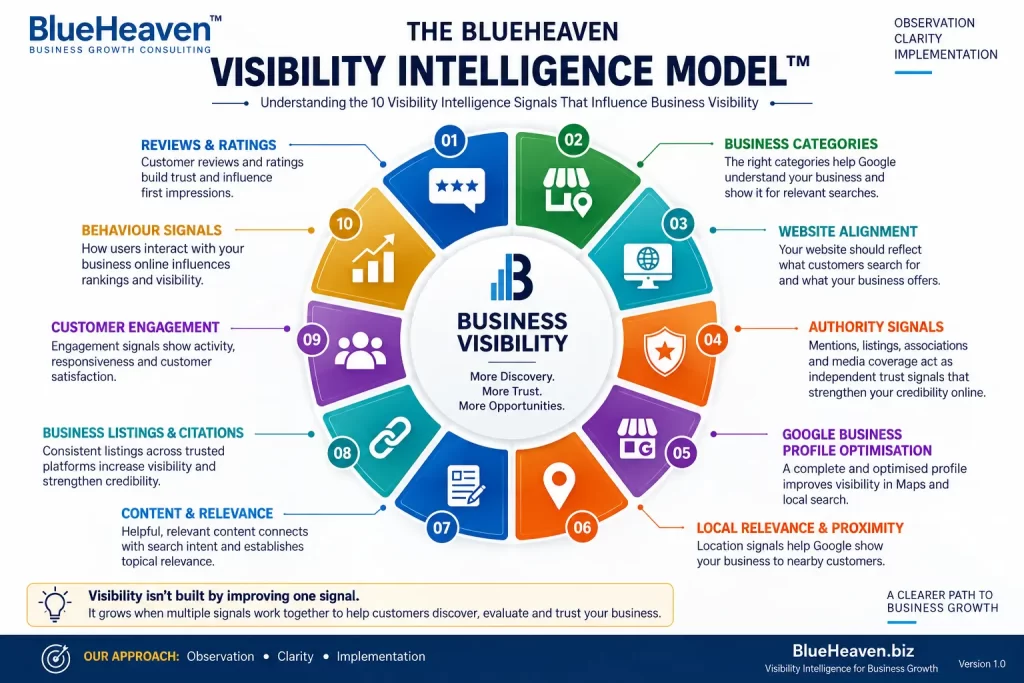
The BlueHeaven Visibility Intelligence Model™ examines ten connected signals:
-
Reviews & Ratings
-
Business Categories
-
Website Alignment
-
Authority Signals
-
Google Business Profile Optimisation
-
Local Relevance & Proximity
-
Content Relevance
-
Listings & Citations
-
Customer Engagement
-
Behaviour Signals
For this preliminary investigation, we focused on the signals most directly connected to product presentation, credibility and buyer evaluation.
A deeper assessment would consider the other relevant signals and examine how the ten signals interact in the context of the business’s market, customers and commercial priorities.
The objective is not to score every signal automatically or assume that every signal carries equal importance. It is to identify which signals matter most for the business situation being investigated.
10. Key Takeaway
This investigation highlights a broader industrial marketing question:
How effectively does an established manufacturer’s online presence connect its capabilities with the needs of the buyers it wants to reach?
Publicly observable information can provide useful starting points for investigation. However, it does not, on its own, establish whether a business has a significant visibility gap or how much that gap might affect its commercial results.
That distinction matters.
Observation identifies what is visible. Investigation establishes what the evidence supports. Interpretation helps determine what deserves attention next.
The BlueHeaven Visibility Intelligence Model™
Ten connected signals. One broader picture of business visibility.
What Comes Next?
The next investigation will examine another business situation to explore what observable visibility signals can—and cannot—tell us about potential business opportunities.
About Visibility Investigations™
Visibility Investigations™ by BlueHeaven.biz examine publicly observable business visibility, identify patterns worth exploring and distinguish evidence from assumptions. They demonstrate a structured approach to investigation, not an assumption that every business examined has a confirmed problem.
Want to Understand Your Business Visibility?
Every business has a different combination of products, customers, markets and growth priorities.
A Visibility Snapshot™ offers a starting point for examining selected visibility signals, identifying notable observations and determining what may deserve closer investigation.
BlueHeaven.biz — Visibility Intelligence & Business Growth Consulting
Observation • Clarity • Implementation