
Putting the 10 Signals Together to Understand Business Visibility

Introduction
In the previous article, we introduced BlueHeaven Visibility Intelligence™ and the ten signals that form the BlueHeaven Visibility Intelligence Model™.
Those ten signals provide different perspectives on business visibility.
But there is an important question that comes next:
What happens when we look at the signals together?
A business may have excellent reviews.
Another may have a strong website.
Another may have extensive listings.
Another may have substantial website traffic.
Yet none of these observations, by itself, tells us the complete visibility story.
The real value of Visibility Intelligence™ begins when we move from individual signals to relationships between signals.
Because sometimes, the most useful insight is not found in one signal.
It is found in the gap between two or more signals.
A Strong Signal Does Not Always Mean Strong Overall Visibility
Imagine a business with hundreds of positive reviews.
That appears to be a strong visibility signal.
But suppose:
-
the business categories do not accurately describe what it offers
-
important products or services are difficult to find on the website
-
external information about the business is inconsistent
-
potential customers have difficulty understanding what makes the business different
The business has a strong review profile.
But does that automatically mean it has strong overall visibility?
Not necessarily.
The reviews tell us something about trust and customer experience.
They don’t tell us everything about discovery, understanding, relevance or engagement.
This is why a single strong signal should not automatically be treated as evidence of strong overall visibility.
The 10 Signals Provide Different Perspectives
The BlueHeaven Visibility Intelligence Model™ consists of:
-
Reviews & Ratings
-
Business Categories
-
Website Alignment
-
Authority Signals
-
Google Business Profile Optimisation
-
Local Relevance & Proximity
-
Content Relevance
-
Listings & Citations
-
Customer Engagement
-
Behaviour Signals
Each signal tells us something different.
The objective is not to make all ten signals look equally strong.
The objective is to understand:
What does each relevant signal tell us, and what happens when we connect that observation with other signals?
That is where the diagnostic value begins.
Signal Relationships Can Reveal More Than Individual Signals
Consider a simple example.
A manufacturer has a comprehensive website.
That might initially appear to indicate strong Website Alignment.
But when we investigate further, we discover that the website contains many products, yet individual product pages are difficult to discover and contain limited information about the problems those products solve.
Now two different observations come together:
Website Alignment
and
Content Relevance
Individually, each signal may appear reasonable.
Together, they may reveal a potential product discoverability gap.
This is an important distinction.
The question is no longer:
“Is the website good?”
It becomes:
“Does the website make the products relevant to the searches, questions and evaluation needs of potential customers?”
That is a much more useful business question.
Think in Relationships, Not Isolated Signals
The ten signals can interact in many different ways.
They do not form a rigid formula.
Instead, they provide opportunities to investigate relationships.
Here are some examples.
Reviews & Ratings + Customer Engagement
A business may have a strong review profile.
But are customers still engaging with the business?
We could investigate:
-
Are people calling?
-
Are they making enquiries?
-
Are they requesting information?
-
Are they taking meaningful next steps?
Strong reviews may support trust.
But trust does not automatically guarantee engagement.
The relationship between these signals can therefore be worth investigating.
Business Categories + Website Alignment
A business’s categories communicate something about its identity.
Its website communicates something too.
What happens when those two representations don’t align?
For example, a business may be categorised broadly while its website specialises in a particular product or market.
Or the business may describe itself one way on its website while external platforms describe it differently.
This can raise an important question:
Is the business consistently communicating what it actually does?
The issue is not necessarily that one platform is “wrong.”
The issue may be a lack of clarity across the customer’s discovery journey.
Website Alignment + Content Relevance
A website can accurately describe a business and still fail to address what potential customers are looking for.
Consider a manufacturer whose website lists:
Product A
Product B
Product C
The products are clearly displayed.
But potential buyers may actually be searching for:
“equipment for solving a particular production problem.”
The website may therefore be aligned with the company’s internal product structure, while being less aligned with the way customers think about their problems.
That creates an interesting investigation:
Is the business presenting what it sells—or helping customers understand how it solves their needs?
This is where Website Alignment and Content Relevance can become particularly important together.
Authority Signals + Reviews & Ratings
Reviews provide evidence of customer experience.
Authority Signals can provide evidence from outside the immediate customer relationship.
For example:
-
industry associations
-
recognised publications
-
relevant business mentions
-
professional references
-
credible third-party sources
Together, these can contribute different forms of credibility.
But again, the objective isn’t to simply collect more signals.
The question is:
Does the evidence surrounding the business support the level of trust the business wants potential customers to have?
Google Business Profile Optimisation + Local Relevance & Proximity
For businesses where local discovery matters, these signals can be closely related.
A well-maintained Google Business Profile can provide useful business information.
But local visibility also involves relevance to the geographic context in which customers are searching.
A business may have an accurate profile but still need to investigate:
-
whether it is relevant to the intended local audience
-
whether the service area is clearly communicated
-
how competitors appear in the same market
-
how customers encounter the business in local search contexts
The important point is that profile optimisation and local relevance are related, but they are not the same thing.
Listings & Citations + Authority Signals
A business may appear on many external websites.
But quantity alone does not establish authority.
A listing on a highly relevant industry platform may tell us something very different from a generic directory listing.
This creates a useful relationship to investigate:
Listings & Citations
→ Where is the business represented?
Authority Signals
→ What credibility does that external presence contribute?
The question therefore becomes:
Is the business represented in the places that matter to its market?
Not:
“How many directories are we listed in?”
Content Relevance + Behaviour Signals
This is another particularly interesting relationship.
Suppose a business publishes content that appears highly relevant to its target audience.
That is one observation.
But what happens after people arrive?
Do they:
-
continue exploring?
-
visit related pages?
-
return later?
-
make an enquiry?
-
leave quickly?
-
repeatedly view a particular topic?
Behaviour patterns can provide another layer of information.
But they must be interpreted carefully.
A behaviour pattern may indicate that something deserves investigation.
It does not automatically explain the reason behind that behaviour.
For example:
A visitor leaves a page quickly.
That could mean the content wasn’t relevant.
But it could also mean they found the information they needed immediately.
Behaviour tells us what happened. It doesn’t always tell us why.
That distinction is fundamental to responsible interpretation.
Customer Engagement + Behaviour Signals
These two signals are closely connected, but they answer different questions.
Customer Engagement
Looks at meaningful actions.
What did the customer do?
Behaviour Signals
Look at patterns.
What appears to be happening repeatedly?
For example:
One enquiry is an engagement.
But if many potential customers repeatedly visit a particular service page, then move to the contact page but do not submit an enquiry, that pattern may deserve investigation.
The individual actions tell us what happened.
The pattern may tell us where to look next.
The Customer Journey Connects the Signals
The ten signals can also be considered in the context of the broader customer journey.
Discovery
Can the potential customer find the business?
Relevant signals may include:
-
Business Categories
-
Google Business Profile Optimisation
-
Local Relevance & Proximity
-
Listings & Citations
-
Content Relevance
Understanding
Once discovered, can the customer understand the business and its relevance?
Relevant signals may include:
-
Business Categories
-
Website Alignment
-
Content Relevance
Trust
Does the business provide enough evidence to support confidence?
Relevant signals may include:
-
Reviews & Ratings
-
Authority Signals
-
Website Alignment
Engagement
Does discovery and evaluation lead to meaningful action?
Relevant signals may include:
-
Customer Engagement
-
Website Alignment
-
Content Relevance
Behaviour
What patterns emerge from what customers do?
Relevant signals may include:
-
Behaviour Signals
-
Customer Engagement
-
Content Relevance
-
Website Alignment
These are not rigid one-to-one relationships.
The same signal can contribute to multiple stages.
That is precisely why the model is useful as an investigation framework.
The Most Interesting Insights May Exist in the Gaps
One of the reasons I find a multi-signal approach useful is that the most important observation may sometimes be a mismatch.
For example:
Strong reputation + weak discoverability
The business is trusted by existing customers but may not be easily discovered by new ones.
Strong visibility + weak engagement
People are finding the business, but relatively few are taking meaningful next steps.
Strong content + weak authority
The business may be demonstrating expertise, but external evidence supporting that expertise may be limited.
Strong website + weak alignment
The website may look professional but may not communicate what potential customers are actually looking for.
Strong local presence + weak conversion
A business may be visible to nearby customers, but visibility may not be translating into sufficient enquiries or appointments.
These are not conclusions that can automatically be drawn from a single metric.
They are investigation questions.
Visibility Gaps Can Occur at Different Stages
This leads to another important way of thinking about visibility.
A business may not have a single “visibility problem.”
It may have a stage-specific gap.
For example:
Before discovery
Potential customers aren’t finding the business.
During understanding
They find it but cannot quickly determine whether it is relevant.
During evaluation
They understand the offering but lack sufficient evidence to develop confidence.
During engagement
They find and trust the business but do not take the desired next step.
After engagement
Customer behaviour reveals patterns that suggest friction or missed opportunities.
The appropriate investigation therefore depends on where the apparent gap occurs.
More Visibility Is Not Always the Answer
This is an important consequence of putting the signals together.
Suppose a business is already receiving substantial relevant traffic.
Simply generating more traffic may not solve the underlying problem.
The investigation may instead reveal:
-
unclear positioning
-
poor product communication
-
weak calls to action
-
difficult enquiry processes
-
inadequate follow-up
-
low conversion
-
or another business constraint
In such a situation, the question should not automatically be:
“How do we get more people to the website?”
It may be:
“What happens to the people who are already arriving?”
That is the difference between activity and diagnosis.
The Framework Helps Us Prioritise
The purpose of investigating multiple signals is not to create a longer to-do list.
It is to create a better order of questions.
For example:
Observation
Relevant visitors are reaching the website.
Investigation
Many appear to view product information but few proceed to enquiry.
Pattern
There may be a gap between product discovery and customer engagement.
Interpretation
The issue may not primarily be traffic generation.
Priority question
What is preventing interested visitors from taking the next step?
Only after that question has been investigated should we decide what action is appropriate.
This is why Visibility Intelligence™ is fundamentally diagnostic.
The 10 Signals Do Not Have Equal Weight in Every Business
There is no universal formula in which each signal receives the same importance.
A local restaurant and a pharmaceutical machinery manufacturer will have very different visibility considerations.
For one business:
Local Relevance & Proximity may be highly significant.
For another:
Authority Signals and Content Relevance may deserve greater attention.
For another:
Customer Engagement and Behaviour Signals may reveal the most useful information.
The model provides the framework.
The business situation determines where we look more closely.
From Signals to Patterns
This is the key transition in Visibility Intelligence™.
Looking at individual signals asks:
“What is happening here?”
Looking at relationships asks:
“How does this connect with something else?”
Looking at patterns asks:
“What might these observations collectively reveal?”
Looking at business implications asks:
“Why might this matter?”
And finally:
“What should we investigate next?”
That is the movement from measurement to understanding.
Observation Before Recommendation
This is central to the way I approach business growth.
When a business wants more enquiries, more customers or more revenue, the natural response can be to recommend:
-
more advertising
-
more content
-
more SEO
-
more social media
-
more promotion
But more activity is not necessarily the answer.
The first step should be understanding the situation.
Observe.
What is actually happening?
Investigate.
Which signals and relationships deserve attention?
Understand.
What patterns are emerging?
Prioritise.
What appears to matter most?
Implement.
What action is appropriate?
Measure.
What happened after the action?
This is the broader Observation • Clarity • Implementation philosophy behind the BlueHeaven approach.
What This Means for Business Growth
Putting the signals together ultimately changes the question we ask about visibility.
Instead of:
“How can we improve our visibility?”
we can ask:
“How is our current visibility working, where might the gaps be, and what opportunities could those gaps reveal?”
That is a much broader business question.
It can lead to different types of recommendations depending on what the investigation reveals.
Sometimes the answer may involve visibility improvement.
Sometimes it may involve customer engagement.
Sometimes it may involve website communication.
Sometimes it may involve conversion.
And sometimes the investigation may reveal that visibility is not the primary constraint at all.
That possibility is important.
A diagnostic framework should be capable of telling us that the problem lies somewhere else.
The BlueHeaven Visibility Intelligence Model™
The ten signals provide the lenses.
The customer journey provides the broader context.
The investigation provides the method.
Together, they help create a more complete picture of Business Visibility.
10 Signals. One Visibility Picture.
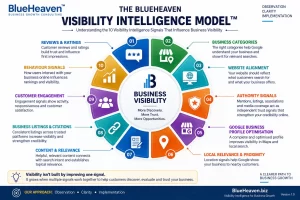
The purpose is not to make every signal perfect.
It is to understand:
Which signals matter?
How are they connected?
What patterns are visible?
What might those patterns mean for the business?
What deserves investigation next?
That is where the model moves beyond a checklist and becomes a consulting tool.
Key Takeaway
Business visibility is rarely determined by one factor.
A business may have strong reviews but weak discoverability.
It may have strong content but weak authority.
It may have good traffic but weak engagement.
It may be highly visible but still have a business growth constraint somewhere else.
The value of the BlueHeaven Visibility Intelligence Model™ lies in looking beyond individual signals and investigating the relationships between them.
The objective is not to optimise everything. It is to understand what matters, what connects, what may be missing, and what deserves attention first.
Because sometimes the most important insight isn’t found in a single signal.
It is found in the pattern between the signals.
Beyond the 10 Signals
The 10 Visibility Intelligence Files introduced the individual signals.
The first article in this new phase explained what Visibility Intelligence™ is.
This article has taken the next step:
The signals become more useful when we investigate how they work together.
The next step is to move from the framework to its application.
What happens when we use these signals to investigate a real business?
That is where Visibility Investigations™ begin.
Want to Understand Where Your Business Stands?
Every business has a different visibility situation.
A Visibility Snapshot™ provides a concise diagnostic view of selected aspects of your business visibility, highlighting observations, potential gaps and areas that may deserve further investigation.
Request a Visibility Snapshot
Observation • Clarity • Implementation
Explore the Visibility Intelligence Series
📚 Browse All Visibility Intelligence Files
What Comes Next?
The next step is to move from understanding the signals to investigating what they reveal about real businesses through Visibility Investigations™.
#VisibilityIntelligence #BusinessVisibility #BusinessGrowth #MarketingStrategy #VisibilityInvestigation