
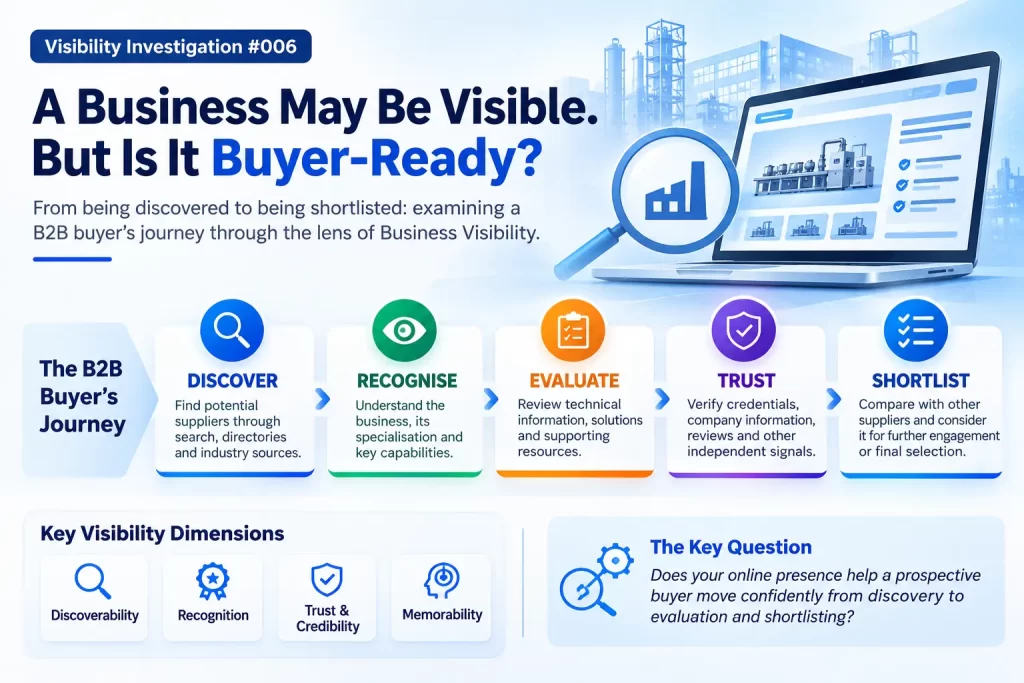
From being discovered to being shortlisted: examining a B2B buyer’s journey through the lens of Business Visibility.
Introduction:
Being Found Is Only the Beginning
Imagine a procurement manager searching for a specialised industrial equipment supplier.
The search produces several results. One company appears in Google, has an established website, maintains a LinkedIn presence and features in industry directories.
The company looks credible at first glance.
But the buyer’s investigation does not stop there.
The website is examined. Product capabilities are compared. Company credentials are checked. Reviews and third-party listings are consulted. Technical information is sought. The buyer may also look for evidence of recent installations, operational capabilities and the supplier’s ability to support a project.
At each stage, the buyer forms an impression.
Some information builds confidence. Other information raises questions.
This brings us to an important distinction:
Being visible to potential customers does not automatically mean being ready for their evaluation.
For Visibility Investigation #006, we examined the public-facing presence of an anonymised company operating in the specialised pharmaceutical and industrial equipment sector.
The investigation was conducted from a prospective buyer’s perspective, following the journey from initial discovery to vendor evaluation and potential shortlisting.
The objective was not simply to assess search rankings or website design. It was to understand what a buyer might encounter when trying to establish whether a supplier deserves serious consideration.
Company identity and potentially identifying details have been withheld. The observations represent a point-in-time review of publicly accessible information, not a formal audit of the company’s internal operations or commercial performance.
The Business Situation
The subject of this investigation is an established B2B manufacturing business serving a specialised industrial market.
Its public-facing presence included:
-
An official corporate website.
-
A Google Business Profile.
-
LinkedIn company presence.
-
Listings on B2B marketplaces and industry directories.
-
References in corporate information platforms.
-
Product and technical information.
-
Public customer and third-party reviews.
At first glance, the business appeared to have a reasonable digital foundation.
It had an identifiable market specialisation, an established business presence and several credibility indicators.
However, looking at the same business through the eyes of a prospective buyer revealed areas where information was fragmented, inconsistent or difficult to obtain.
The investigation was organised around four dimensions of Business Visibility:
-
Discoverability
-
Recognition
-
Trust & Credibility
-
Memorability
We then examined how these dimensions influenced the buyer’s progression through the procurement journey.
The Investigation
1. Discoverability: Can Buyers Find the Business?
The investigation revealed a difference between searching for a company by name and searching for the products or solutions it offers.
Strong presence in direct searches
When a buyer already knows the company’s name, its official website and business-related listings can be found through direct searches.
Its presence across search results, map listings and corporate information platforms provides several routes for identifying the business.
This is a positive starting point.
Fragmented presence across B2B marketplaces
The investigation also identified multiple seller profiles on a B2B marketplace under variations of the business name.
Different profiles appeared to contain different company or contact details.
For a prospective buyer, this can create unnecessary questions:
-
Which profile represents the official business?
-
Which contact should receive an enquiry?
-
Are these separate entities or different representations of the same company?
-
Which listing contains the most reliable information?
Multiple listings are not automatically harmful. However, when they contain inconsistent information, they can divide attention and make it harder for buyers to establish which representation is authoritative.
Geographic information needs consistency
The business’s public information used a major metropolitan reference, while its manufacturing and registered business locations were associated with a different industrial area.
This distinction may be perfectly legitimate.
However, a buyer searching by location or checking the company’s operational presence may need to reconcile the different references.
Buyer implication: A business may be discoverable, yet still create friction when a prospective customer tries to establish where it operates and which business details are authoritative.
2. Recognition: Does the Buyer Clearly Identify the Business?
Discoverability brings the business into view. Recognition helps the buyer understand who the business is and what it stands for.
Clear technical specialisation
The official website and LinkedIn presence communicated a distinct area of technical specialisation.
The product categories and associated engineering capabilities helped establish the company’s place within its industry.
This is valuable in a specialised B2B market, where buyers often search for specific equipment capabilities rather than general manufacturing services.
Separate social identities
The investigation found a primary company presence and a separate division-related LinkedIn page.
While separate divisions can serve legitimate business purposes, the relationship between the pages should be clear.
If the company name, organisational description or business classification differs across profiles, buyers may wonder whether they are dealing with the same legal or commercial entity.
Similar-name search confusion
Another observation concerned the possibility of confusion with an unrelated business having a phonetically similar name.
This is particularly relevant when buyers use voice search, broad search phrases or incomplete company names.
A business cannot control every search result, but it can strengthen its own identity through consistent naming, clear descriptions and authoritative digital profiles.
Buyer implication: A recognisable brand should be consistently identifiable across the places where prospective customers encounter it.
3. Trust & Credibility: Do the Available Signals Reinforce Confidence?
In B2B capital-equipment purchases, trust is rarely established through a single website visit.
Buyers may examine company history, technical capabilities, regulatory credentials, customer references, reviews and other independent information before considering a supplier.
Strong enterprise credibility indicators
The business presented several positive credibility indicators, including:
-
An established operating history.
-
International market presence.
-
Regulatory and quality-related credentials.
-
Relationships with recognised technology partners.
-
References to established pharmaceutical customers.
These are meaningful trust anchors in a specialised industrial market.
They help communicate experience, capability and familiarity with demanding customer requirements.
Positive local customer feedback
The company’s Google Business Profile showed positive customer feedback at the time of the investigation.
Such feedback can contribute to confidence, particularly when prospective customers are checking whether a business is established and actively operating.
Conflicting third-party feedback
However, the picture was not entirely consistent.
Other public review platforms displayed less favourable ratings and critical feedback. Employee-review platforms also contained mixed opinions about the organisation.
These sources should not be treated as interchangeable.
Customer reviews, employee reviews and independent business information reflect different experiences and have different relevance to a prospective buyer.
Nevertheless, a buyer conducting deeper research may encounter all of them.
The absence of a visible response or explanation can leave questions unanswered.
Inconsistent corporate information
The investigation also identified differences in publicly available information concerning the company’s history, size and leadership details.
Some differences may arise from outdated directories, third-party data collection or inconsistent updates.
The important issue is not simply that differences exist. It is whether the business has taken sufficient care to establish consistent, authoritative information across its public-facing channels.
Buyer implication: Strong credentials can build confidence, but conflicting information elsewhere may make buyers pause and seek clarification.
4. Memorability: Will Buyers Remember the Right Business?
A prospective buyer may encounter several suppliers while researching a particular equipment category.
The ability to associate a company with a clearly defined specialisation helps it remain memorable.
Strong category association
The business had established a recognisable association with its specialist equipment category.
For a buyer already familiar with the company, this can strengthen recall.
Inconsistent information across touchpoints
However, differences in company details across directories, social profiles and other public platforms can weaken the overall impression.
A buyer encountering the business on one platform may see information that does not fully match what appears elsewhere.
This creates a fragmented picture of the organisation.
Buyer implication: A memorable brand is not just a name or logo. It is a consistent identity reinforced across the touchpoints where customers encounter it.
Following the B2B Buyer’s Journey
The four dimensions above help us understand the business’s overall visibility. But how do they influence the actual procurement journey?
To examine this, we considered three broad stages.
Stage 1: Category Search – Before the Buyer Knows the Name
At this stage, the buyer is looking for a product, solution or supplier category rather than a particular company.
The investigation found that the business had visibility through industry directories, trade-related platforms and exhibitor information.
These channels can be valuable because they bring suppliers into the consideration set of buyers already researching the industry.
However, broader unbranded search visibility appeared less consistent.
For example, a procurement or engineering professional searching for a specific equipment capability may encounter established competitors, industry articles and comparison resources without necessarily finding this supplier prominently.
This matters because buyers who do not already know a company’s name may never reach its website.
The question worth asking: Is your business visible only when buyers search for your name, or also when they search for the products, problems and solutions you specialise in?
Stage 2: Website Evaluation & Technical Due Diligence
Once a buyer reaches the website, the nature of the evaluation changes.
The buyer is no longer simply asking, “Who are you?”
The questions become more specific:
-
Can this supplier meet our technical requirements?
-
Does the equipment support our process and production needs?
-
What are the available configurations and specifications?
-
What evidence is available to support the supplier’s claims?
-
Can we evaluate the solution before contacting the sales team?
The investigated website communicated technical capabilities and included information relevant to engineering and procurement professionals.
However, there appeared to be opportunities to make technical self-service research more comprehensive.
For example, buyers of capital equipment may want access to:
-
Detailed technical brochures.
-
Equipment specifications and configuration details.
-
User Requirement Specification (URS) support material, where appropriate.
-
Equipment footprint and layout information.
-
Relevant case studies or application examples.
-
Current machine demonstrations.
-
Evidence of recent engineering and technology developments.
The website relied substantially on general product information and enquiry-oriented calls to action.
This means a buyer seeking more detailed information may need to contact the sales team before obtaining answers to basic evaluation questions.
That is not necessarily wrong. Some technical and commercial details should be shared only after understanding the buyer’s requirements.
But there is a balance between protecting sensitive information and making the initial evaluation process convenient.
The investigation also found that some prominently discoverable video material was several years old.
Older videos may still demonstrate useful capabilities. However, in a market where technology and automation continue to evolve, buyers may also want to see more recent demonstrations.
The question worth asking: Does your website help a technically qualified buyer evaluate your capabilities, or does it make the buyer depend on repeated sales enquiries to obtain basic information?
Stage 3: Risk Assessment & Vendor Shortlisting
This is where the buyer moves beyond product interest and examines the supplier as a business partner.
The company had several strong credibility indicators, including established customer relationships, international associations and technical credentials.
These can help reduce perceived risk.
However, a deeper background check may also reveal:
-
Differences in publicly stated company information.
-
Inconsistent location references.
-
Variations in company-history claims.
-
Conflicting third-party reviews.
-
Separate profiles that do not clearly explain their relationship.
None of these observations independently establishes a problem with the company’s ability to deliver.
But they may create questions that the buyer needs to resolve before proceeding.
In a high-value procurement decision, even relatively small information gaps can prompt additional verification.
The question worth asking: When a buyer cross-checks your business before including it in a vendor shortlist, does every important public-facing source reinforce the same credible picture?
Questions Worth Investigating
This investigation highlights questions that other B2B manufacturers and industrial suppliers can ask about their own visibility.
Discoverability
-
Can prospective buyers find you through product-category and problem-related searches, not just your company name?
-
Are your website, industry listings and marketplace profiles directing buyers to the correct business information?
-
Are your location references consistent and easy to understand?
Recognition
-
Is your business identity consistent across your website, LinkedIn and third-party profiles?
-
Are separate divisions, brands or business units clearly connected to the main organisation?
-
Could a similar company name create search confusion?
Trust & Credibility
-
Are your business history, credentials and company details consistently represented?
-
Are customer reviews and other public feedback being monitored and addressed appropriately?
-
Can buyers easily verify the claims made on your website?
Memorability
-
Is your specialisation clear enough for buyers to associate your business with a particular product category or capability?
-
Does your digital presence reinforce the same identity across different platforms?
-
Are your technical content, case studies and demonstrations current and relevant?
Buyer Readiness
-
Can a prospective customer obtain sufficient information to make an initial technical assessment?
-
Does your website support the needs of engineering, procurement and management professionals?
-
Are there unanswered questions that may slow down vendor evaluation?
These questions are not a substitute for a complete business or website audit. They provide a starting point for examining your presence from the customer’s perspective.
The Visibility Intelligence Perspective
This investigation reinforces an important principle:
Business Visibility is not simply about appearing in search results. It is about helping the right people discover, recognise, trust and remember your business across the channels they use before making a buying decision.
In this case, the business had several positive visibility foundations.
It could be discovered through direct searches, had a recognisable technical specialisation and presented meaningful enterprise credentials.
Yet the buyer’s journey revealed opportunities to improve the consistency, accessibility and usefulness of the information available across its digital touchpoints.
This is why visibility should be examined as a connected system rather than as a collection of isolated marketing activities.
The Blue Heaven Visibility Intelligence Model™
The Blue Heaven Visibility Intelligence Model™ uses ten signals to examine important aspects of business visibility, particularly across Google and local search environments.
Ten connected signals. One broader picture of business visibility.
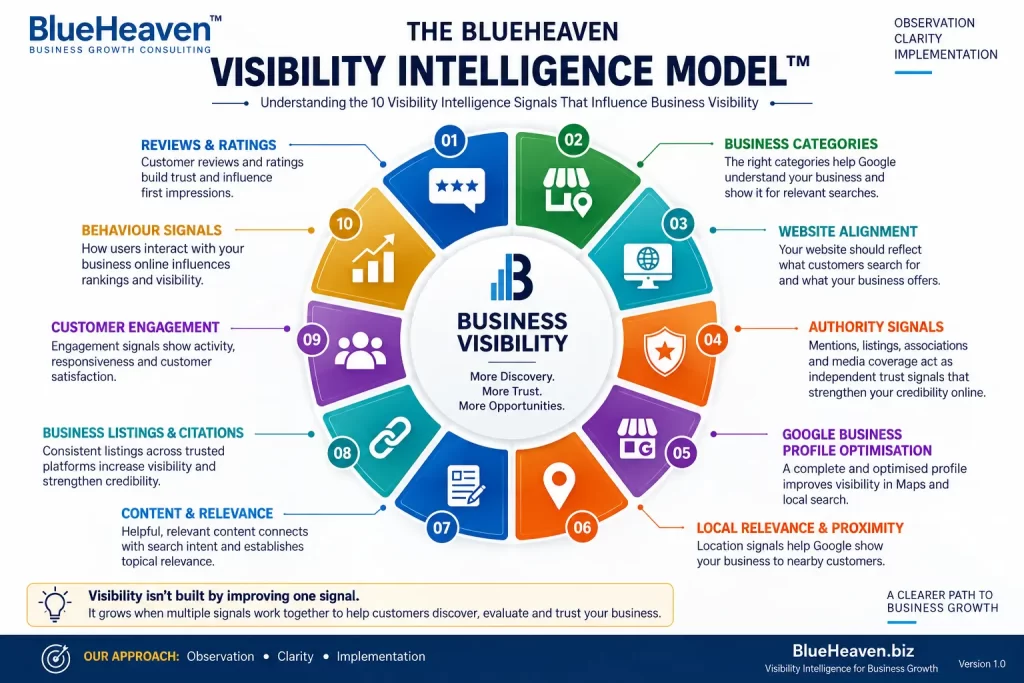
Not every signal carries equal importance in every business situation.
More importantly, the B2B procurement journey examined in this investigation extends beyond local search visibility. It also requires attention to technical content, product evaluation, corporate credibility and the information buyers need during vendor assessment.
The ten signals provide a structured visibility lens. The wider buyer-journey investigation helps identify where additional examination may be necessary.
Together, they encourage businesses to look beyond rankings and ask a more commercially relevant question:
Is our presence helping potential customers move closer to choosing us?
Key Takeaway
A business can have an established website, appear in search results, maintain industry listings and display impressive credentials.
Yet, when a prospective buyer examines the business more closely, inconsistent information, fragmented profiles, limited technical resources or unanswered questions may create hesitation.
The lesson is not that every business must publish every technical document or respond to every review in the same way.
It is that businesses should understand what their buyers need to know at each stage of the decision-making process.
Visibility gets you discovered. Consistency builds recognition. Credibility strengthens trust. Relevant information helps buyers move forward.
Being visible is important.
Being buyer-ready is equally important.
Consultant’s Observation
When I examine a business, I do not look only at what the company wants to communicate.
I also consider what a prospective customer is likely to see, search for, question and verify.
This change in perspective can reveal gaps that may not be obvious when a business reviews its own website or marketing activities from the inside.
A company may believe that its credentials, products and capabilities are adequately represented. A buyer, however, may still need to search across multiple platforms to connect the information and establish confidence.
That is why I believe businesses should periodically examine their presence from the buyer’s point of view.
Not merely to ask whether they are visible, but whether their visibility is helping them become a credible and considered choice.
Observation. Clarity. Implementation.
What Comes Next?
In the next Visibility Investigation, we will continue examining how businesses appear to prospective customers and what their public-facing presence communicates at important decision-making moments.
Because the objective is not simply to be seen.
It is to be discovered, recognised, trusted, remembered and considered.
About Visibility Investigations™
Visibility Investigations™ is a Blue Heaven initiative that examines how businesses appear across relevant digital and market touchpoints.
Each investigation takes an observational approach to discover how a prospective customer may encounter, evaluate and perceive a business.
The objective is to identify visibility gaps, inconsistencies and opportunities that businesses may otherwise overlook.
These investigations are based on publicly accessible information at the time of review. They are observational studies, not endorsements, formal certifications or assessments of a company’s internal performance.
Want to Understand How Your Business Appears to Potential Buyers?
Your business may be doing excellent work, but are the right people discovering it, recognising its strengths and finding enough reasons to consider it?
A Visibility Snapshot™ can provide an initial view of selected aspects of your business visibility and highlight areas that may deserve further attention.
Explore your business visibility with Blue Heaven.
Get noticed. Be remembered. Get chosen.
#B2BBusinessVisibility #BuyerJourney, #SupplierVisibility, #B2BDiscoverability, #VendorShortlisting, #BusinessCredibility, #VisibilityIntelligence