
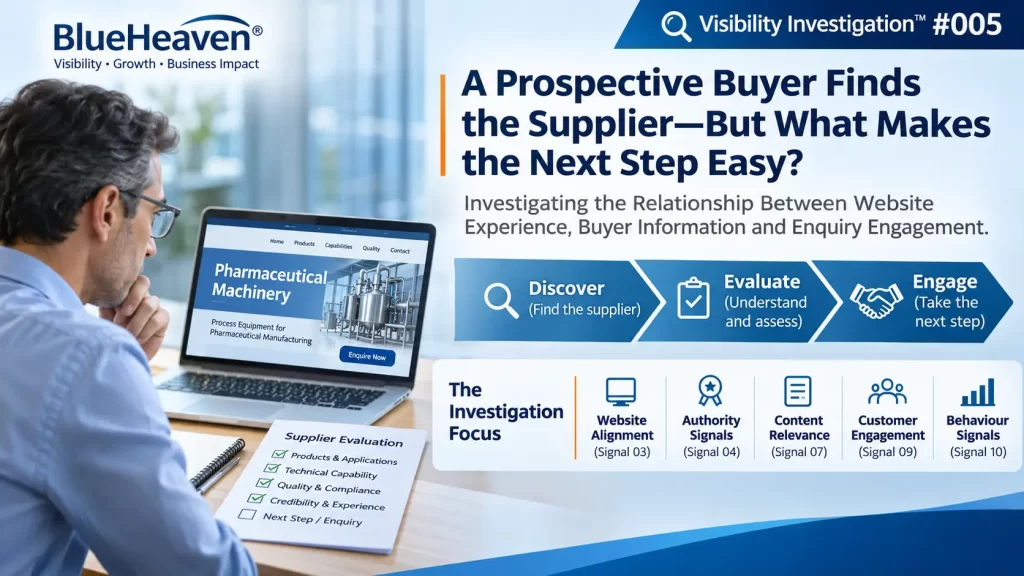
Investigating the Relationship Between Website Experience, Buyer Information and Enquiry Engagement.
Introduction
For a B2B manufacturer, being discovered by a prospective buyer is an important first step. But discovery alone does not create a business opportunity.
Consider a pharmaceutical machinery manufacturer whose website appears to have all the essential elements of an online presence. It has product pages, company information, technical descriptions, photographs and contact details. The business is also active on professional platforms such as LinkedIn.
A prospective buyer discovers the company and visits its website.
But what happens next?
Can the buyer quickly identify the products or solutions relevant to their requirements? Is there enough information to understand the manufacturer’s capabilities? Can the buyer establish whether the supplier deserves further consideration? And, when interest develops, is the next step towards an enquiry clear?
These are important questions because a business may have an online presence without necessarily making the buyer’s evaluation journey straightforward.
In this Visibility Investigation™, we examine an illustrative B2B manufacturing scenario to understand how website experience, buyer information and customer engagement work together.
The purpose is not to declare that a particular business has an enquiry-generation problem. It is to investigate the questions that emerge when we examine the connected signals influencing a prospective buyer’s journey.
The Business Situation
Imagine an established pharmaceutical machinery manufacturer offering several categories of equipment to pharmaceutical and related industries.
The company has invested in its website and maintains a professional presence on LinkedIn. Its online assets provide information about its product range, manufacturing capabilities and business background.
At first glance, the company appears to have a reasonable digital foundation.
However, a prospective buyer does not necessarily approach the website with the same perspective as the manufacturer.
The buyer may be looking for a particular type of equipment, comparing potential suppliers, assessing technical suitability or trying to identify manufacturers who can meet specific requirements.
The buyer’s questions could include:
-
Does this manufacturer offer the equipment or solution I need?
-
Is the product suitable for my intended application?
-
What relevant capabilities and experience does the company have?
-
Can I find sufficient information to evaluate the supplier?
-
Whom should I contact for further clarification?
-
What information should I provide when making an enquiry?
The investigation, therefore, shifts attention from simply examining what a business publishes online to considering how effectively that information supports the prospective buyer.
The Visibility Investigation
We examine five signals from the BlueHeaven Visibility Intelligence Model™ that are particularly relevant to this situation.
Signal 03 — Website Alignment
Does the website connect the manufacturer’s offerings with the buyer’s requirements?
A manufacturer’s website often reflects the way the company organises its products and capabilities internally.
Products may be presented under equipment categories, technical classifications or manufacturing divisions. This arrangement may make sense to the company, but it does not automatically make the information easy for a prospective buyer to navigate.
A buyer may approach the website with a specific application, production requirement or operational challenge in mind.
The investigation should examine:
-
Whether product categories are clearly organised.
-
Whether product pages explain applications and intended uses.
-
Whether buyers can distinguish between different equipment models or solutions.
-
Whether the website communicates relevant manufacturing capabilities.
-
Whether the navigation helps visitors find information without unnecessary effort.
-
Whether the website’s messaging is consistent with the company’s other online platforms.
The important distinction is between presenting information about the business and organising that information around the needs of its prospective customers.
A website can contain considerable information and still leave buyers searching for answers.
Signal 04 — Authority Signals
Can prospective buyers establish the manufacturer’s credibility?
In pharmaceutical and industrial B2B markets, supplier evaluation can involve several people and departments.
A prospective buyer may need to establish the manufacturer’s experience, technical capabilities, quality practices, industry background and ability to support the requirements of a particular project.
A website that makes broad statements about quality, reliability or expertise may communicate confidence, but buyers may also look for supporting evidence.
The investigation should examine whether relevant information is available about:
-
Manufacturing experience and industry presence.
-
Technical capabilities and engineering expertise.
-
Quality systems and applicable compliance documentation.
-
Product development and application knowledge.
-
Customer references or documented project experience, where disclosure is permitted.
-
Relevant supplier credentials and procurement-related qualifications, where verifiable.
For pharmaceutical machinery manufacturers, accurate communication of quality and compliance-related information is particularly important.
Claims should be specific and supported by appropriate documentation. Regulatory approvals, certifications and compliance capabilities must not be presented as interchangeable concepts.
Similarly, vendor registration or supplier qualification should not be confused with a guarantee of receiving enquiries, invitations to tender or purchase orders.
The investigation is concerned with whether a prospective buyer can establish credibility from available evidence—not merely whether the manufacturer claims to be credible.
Signal 07 — Content Relevance
Does the content answer the questions a prospective buyer is likely to ask?
Product descriptions are necessary, but they may not provide everything a buyer needs to make an initial assessment.
For example, a product page may mention the equipment’s specifications and features. But a prospective buyer may also want to understand:
-
Which applications is the equipment intended for?
-
What production requirements can it address?
-
What distinguishes one model from another?
-
What technical information is available?
-
What should a buyer consider before selecting this equipment?
-
What additional information can be obtained from the manufacturer?
This is where content relevance becomes important.
Useful B2B content should help buyers understand the product, its application and its relevance to their requirements.
Depending on the business, this may include:
-
Detailed product descriptions.
-
Application-oriented information.
-
Product comparison guides.
-
Technical brochures and downloadable documents.
-
Frequently asked questions.
-
Educational articles and explanatory videos.
-
Information addressing common buyer concerns.
The objective is not to publish more content simply to make the website appear active.
It is to make the available information useful at different stages of the buyer’s evaluation process.
Signal 09 — Customer Engagement
Does the online presence make it easy for interested buyers to take the next step?
A prospective buyer may have found the right product, understood its application and developed an interest in the manufacturer.
At this stage, the buyer needs a clear way to engage.
The investigation should examine the available engagement pathways.
For example:
-
Are contact details easy to locate?
-
Is the enquiry form accessible and straightforward?
-
Does the website explain what information a buyer should provide?
-
Are relevant telephone, email or other contact options available?
-
Are calls to action meaningful and appropriately placed?
-
Is there a clear route for buyers seeking technical or commercial clarification?
-
Do professional platforms provide a consistent route towards further engagement?
A generic button labelled “Contact Us” may be adequate for some situations. In others, more specific options such as “Request Product Information”, “Enquire About This Equipment” or “Discuss Your Requirement” may communicate the next step more clearly.
However, the most suitable approach depends on the business and its customers.
The objective is to reduce unnecessary friction between a buyer’s interest and the opportunity to initiate a meaningful conversation.
Signal 10 — Behaviour Signals
What does visitor behaviour reveal about the effectiveness of the online experience?
The preceding signals help us examine what a prospective buyer can see and do.
Behaviour Signals take the investigation further by examining what visitors actually do, where appropriate data is available.
For example:
-
Which product pages attract visitor interest?
-
How do visitors navigate between pages?
-
Do visitors explore technical information or download brochures?
-
Which pages are frequently exited?
-
Do visitors proceed from product information to contact or enquiry pages?
-
Which sources bring visitors to the website?
-
Are there identifiable patterns in enquiry-related interactions?
These questions require appropriate measurement tools and access to relevant analytics or website data.
Publicly available website information cannot establish how visitors behave, how many enquiries are generated or why a particular visitor does not make contact.
That distinction is important.
We can identify questions worth investigating from a public-facing website. We cannot claim to know actual visitor behaviour without supporting evidence.
Behaviour Signals help distinguish assumptions about customer engagement from what measured customer activity reveals.
How the Signals Connect
The five signals should not be examined as independent website features.
They influence different parts of the buyer’s experience.
Consider the following sequence:
From discovery to enquiry
-
Website Alignment — Signal 03
The buyer finds information relevant to the product or solution being considered.
-
Authority Signals — Signal 04
The buyer looks for evidence that the manufacturer has the relevant capabilities and credibility.
-
Content Relevance — Signal 07
The buyer finds information that helps answer questions and assess suitability.
-
Customer Engagement — Signal 09
The buyer can identify a suitable way to contact the manufacturer or request further information.
-
Behaviour Signals — Signal 10
Available data helps the business understand how visitors interact with its online presence and where further investigation may be needed.
This sequence is illustrative, not a fixed or universal buyer journey. B2B procurement decisions may involve several stakeholders, multiple interactions and extended evaluation periods.
Nevertheless, it highlights an important consideration: the effectiveness of one signal may depend on how it connects with others.
A website may be well organised, but if its content does not address buyer questions, the experience may remain incomplete.
A manufacturer may possess considerable technical credibility, but if that credibility is not communicated through accessible evidence, prospective buyers may find it difficult to assess.
Similarly, useful product information and strong credentials may not translate into engagement if the next step is unclear.
The investigation, therefore, looks beyond individual website elements to understand the overall experience being presented to prospective buyers.
What Cannot Be Concluded From Public Information Alone
An evidence-led investigation must recognise its limitations.
From publicly accessible online information, we may be able to examine website structure, product information, published credentials, contact pathways and the consistency of the manufacturer’s online presence.
However, we cannot automatically establish:
-
The number or quality of enquiries the business receives.
-
The percentage of website visitors who become enquiries.
-
Whether prospective buyers abandon the website.
-
Whether the sales team follows up enquiries effectively.
-
Whether enquiries are converted into quotations or orders.
-
Whether the website is responsible for any business growth constraint.
These questions require additional information, such as website analytics, enquiry records, customer feedback and sales-process data.
It is also possible that the business receives enquiries through existing relationships, referrals, exhibitions, distributors or direct sales activity that is not visible through its website.
A public-facing investigation should not mistake the absence of visible evidence for the absence of business capability or activity.
The Visibility Intelligence Perspective
A business should not measure the value of its online presence only by whether its website exists, how many products it displays or how frequently it publishes content.
The more important question is whether its online presence helps prospective buyers move forward.
Can they discover the relevant offering?
Can they understand what the manufacturer provides?
Can they establish sufficient credibility to consider the supplier?
Can they find information that supports their evaluation?
And can they take the next step towards meaningful engagement?
These questions connect visibility with business growth.
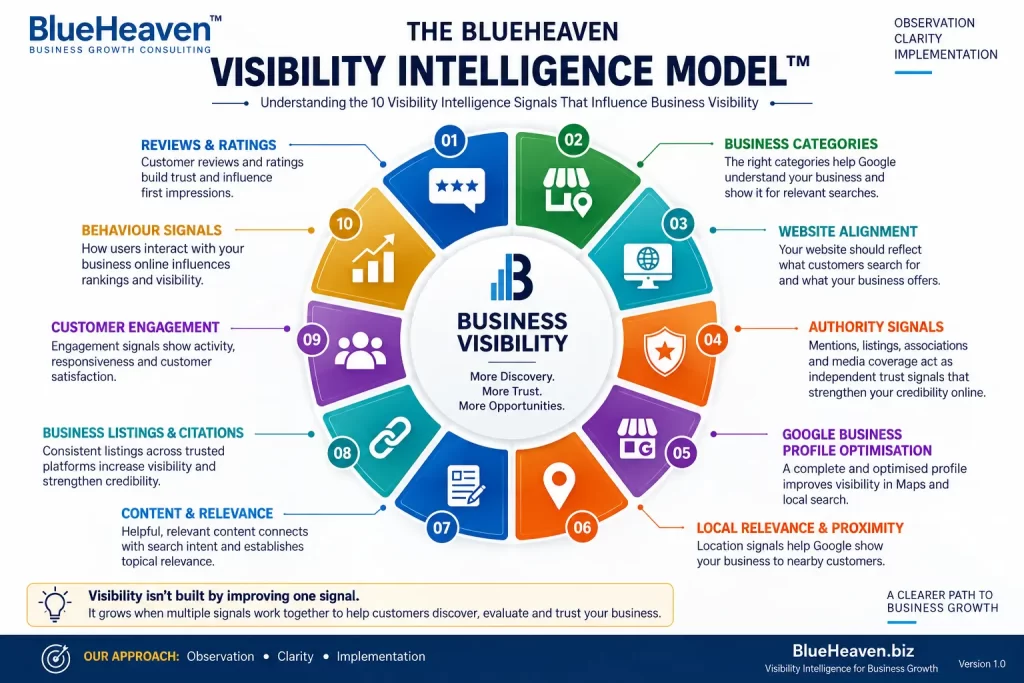
The purpose of the BlueHeaven Visibility Intelligence Model™ is to investigate how effectively a business is being discovered, understood, trusted and engaged with—and what customer behaviour reveals about the resulting opportunities.
It provides a structured way to examine connected signals rather than treating online visibility as a collection of disconnected marketing activities.
The BlueHeaven Visibility Intelligence Model™
Ten connected signals. One broader picture of business visibility.
Key Takeaway
Being discovered is not the same as being considered. And being considered is not the same as receiving an enquiry.
For a B2B manufacturer, the online experience should do more than display products and company information. It should help prospective buyers understand the offering, assess the supplier’s credibility, find relevant answers and identify a clear next step.
The challenge is not necessarily to add more marketing activities.
It is to understand whether the existing online presence works together to support the buyer’s journey—and identify where meaningful improvements may be possible.
Consultant’s Observation
In my experience of working with businesses across advertising, marketing and business development, it is easy to focus on individual activities: a website, a LinkedIn presence, product brochures or digital campaigns.
Each may have a purpose.
But the larger question is whether these activities work together to support the business’s objectives.
A prospective buyer does not necessarily distinguish between a company’s website, its content, its credentials and its communication channels. The buyer experiences the business through all these touchpoints.
That is why I believe business visibility should be investigated as a connected system.
The first step is not to recommend another marketing activity. It is to understand what is already happening, identify what deserves attention and determine which improvements are likely to make a meaningful difference.
Observation. Clarity. Implementation.
What Comes Next?
In this investigation, we examined how a prospective buyer’s online experience can influence the progression from initial interest towards meaningful engagement.
But this is only one part of the larger business visibility picture.
In the next Visibility Investigation™, we will examine another business situation and explore what the connected signals reveal.
Because every business has a different market, different customers and different growth challenges, each investigation must begin with observation rather than assumptions.
About Visibility Investigations™
Visibility Investigations™ is an ongoing BlueHeaven series examining how businesses are discovered, understood, trusted and engaged with across their online presence.
Each investigation explores a business situation through relevant signals from the BlueHeaven Visibility Intelligence Model™.
The purpose is to identify patterns, opportunities and questions that deserve further examination—not to make unsupported claims about a business’s performance.
Want to Understand What Your Online Presence Is Communicating?
Your website, business profiles, professional platforms and published content all contribute to how prospective customers discover and evaluate your business.
A Visibility Snapshot™ offers a focused preliminary examination of selected visibility signals to identify observations and possible areas for further investigation.
It is a starting point for understanding your online presence—not a substitute for a comprehensive business or marketing diagnosis.
Explore Visibility Intelligence & Business Growth Consulting — BlueHeaven.biz
#VisibilityIntelligence #B2BMarketing #PharmaceuticalIndustry #BusinessGrowth #VisibilityInvestigation