
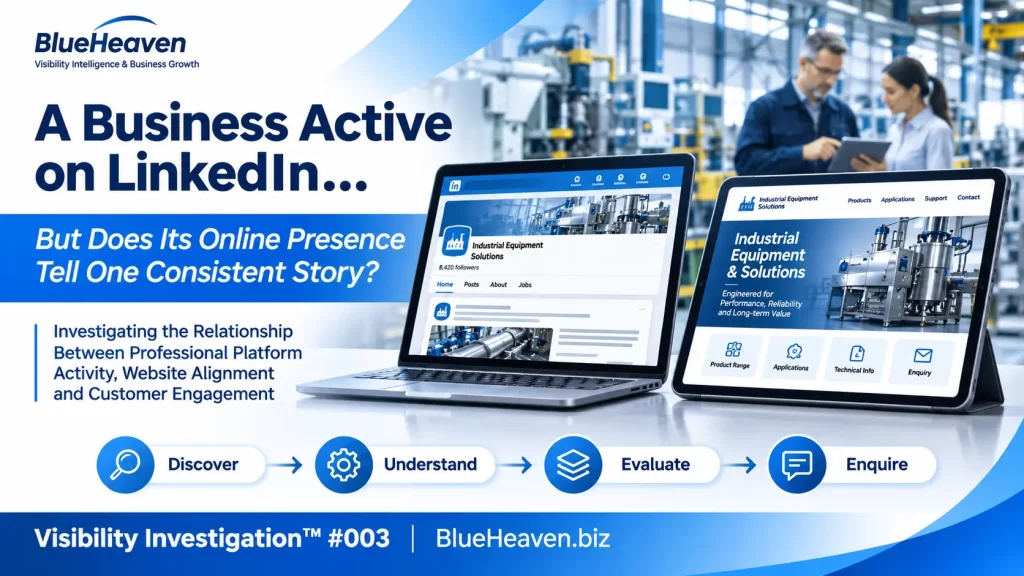
Investigating the Relationship Between Professional Platform Activity, Website Alignment and Customer Engagement
Introduction:
Visibility Is More Than Being Active
A business can maintain an active LinkedIn presence, regularly publish updates and share technical information about its products and capabilities.
It may also have a website containing detailed product information, technical specifications and company credentials.
At first glance, these appear to be positive indicators of an established online presence.
But there is another question worth examining:
Do these different online touchpoints work together to help prospective customers understand the business, evaluate its capabilities and take the next step?
For B2B businesses, particularly those selling industrial products, machinery, equipment or technical solutions, visibility is not simply about appearing on a platform or publishing content.
It is also about the relationship between what a business communicates, what a prospective buyer discovers and what happens when that buyer wants to know more.
This Visibility Investigation™ explores that relationship.
The Business Situation
Consider an established B2B industrial equipment manufacturer.
The business has:
-
An active LinkedIn company page.
-
Regular posts about products, applications and industry developments.
-
A website presenting its product range and technical capabilities.
-
Product-related information that may interest engineers, procurement professionals and business decision-makers.
-
A presence on other relevant digital platforms.
These are useful elements of its online presence.
However, examining each element independently may not reveal the complete picture.
The LinkedIn page may communicate the company’s activities, while the website may present its products in a different way. Technical content may be available, but prospective buyers may have to navigate several pages to find the information relevant to their requirements.
The question is not whether the business is active online.
It is whether its different online assets collectively support the buyer’s journey.
Looking Beyond Individual Metrics
Suppose an initial public-information review identifies the following observations.
| Area examined | Initial observation |
|---|---|
| LinkedIn presence | The company maintains an active professional presence and publishes business-related content. |
| Website | Product and technical information is available. |
| Website alignment | The connection between the company’s LinkedIn messaging and website presentation deserves closer examination. |
| Content relevance | Some content addresses products and applications, but its usefulness across different buyer needs requires further assessment |
| Customer engagement | Contact and enquiry pathways are visible, but their effectiveness cannot be established from public information alone. |
| External credibility | Relevant industry references and third-party mentions warrant examination. |
These observations do not establish that the business has a visibility problem.
They provide a starting point for asking more meaningful questions.
Observation 1: Is LinkedIn Activity Translating Into Meaningful Discovery?
An active LinkedIn presence can help a B2B business communicate its expertise, share product information and maintain visibility among professional audiences.
However, activity alone does not establish whether the right people are seeing or engaging with that content.
Consider the following questions:
-
Is the content relevant to the company’s intended buyers?
-
Does it communicate the company’s actual capabilities?
-
Does it address the problems, applications and requirements of prospective customers?
-
Does the company page provide a clear route to relevant product or service information?
-
Is there evidence that professional engagement is progressing into meaningful business enquiries?
A post receiving reactions or comments is an observable engagement metric.
It does not, by itself, establish buyer interest, purchase intent or commercial outcomes.
The distinction matters.
Professional platform activity and business discovery are related, but they are not the same thing.
Observation 2: Does the Website Continue the Story?
A prospective buyer who discovers a manufacturer through LinkedIn may visit its website to understand the business in greater detail.
This creates an important transition.
The website should help the visitor understand:
-
What the company manufactures or supplies.
-
Which industries and applications it serves.
-
What makes its products or solutions relevant.
-
What technical information is available.
-
How to request specifications, discuss requirements or make an enquiry.
If the LinkedIn content communicates one set of capabilities while the website presents them differently, the buyer may need to make additional effort to understand the business.
Similarly, a website may contain extensive technical information but still make it difficult to identify the right product or application.
This raises a question connected to Signal 03 — Website Alignment:
Does the website reinforce the business identity and value proposition communicated through its other online touchpoints?
The existence of a website is not enough. Its role in the wider discovery and evaluation process deserves examination.
Observation 3: Is the Content Relevant to the Buying Journey?
B2B buying decisions often require more information than simply knowing that a supplier exists.
A prospective buyer may want to understand:
-
Product specifications and technical capabilities.
-
Applications and compatibility.
-
Industry experience.
-
Installation, service and support arrangements.
-
Relevant certifications and credentials.
-
The supplier’s ability to meet particular requirements.
A company may publish regularly on LinkedIn and maintain product information on its website.
But are these two content environments addressing the questions buyers actually need answered?
This brings Signal 07 — Content Relevance into the investigation.
The objective is not to measure how much content has been published.
It is to understand whether the available content helps the intended audience discover, understand and evaluate the business.
Observation 4: Does the Online Presence Provide a Clear Path to Engagement?
Imagine a prospective buyer who has discovered the company, understood its product range and found information relevant to an application.
What happens next?
Can the buyer easily:
-
Identify the appropriate contact person?
-
Request a product catalogue or technical specification?
-
Discuss a particular application?
-
Submit an enquiry?
-
Find the relevant sales or technical contact?
These questions bring Signal 09 — Customer Engagement into focus.
A visible contact form or telephone number indicates that a contact mechanism exists.
It does not prove that enquiries are being received, answered promptly or converted into business.
That would require additional evidence, such as enquiry records, response data or CRM information.
The investigation must distinguish between an observable pathway and its actual performance.
Looking at the Connections Between Signals
The observations above become more useful when considered together.
| Connected signals | Question worth investigating |
|---|---|
| Website Alignment + Content Relevance | Does the website present relevant product information in a way that supports buyer understanding? |
| Content Relevance + Professional Platform Activity | Does the content shared on LinkedIn lead interested audiences towards useful supporting information? |
| Authority Signals + Content Relevance | Does the business’s external credibility reinforce the expertise communicated through its content? |
| Website Alignment + Customer Engagement | Can prospective buyers move easily from product evaluation to an appropriate enquiry? |
This is where individual metrics may fail to reveal the wider picture.
A business may have an active LinkedIn page, a technically detailed website and visible contact information.
Yet the relationship between these assets may still raise important questions.
Conversely, the presence of these assets may already support an effective buyer journey. That possibility must also remain open until sufficient evidence is available.
What Cannot Be Concluded From Public Information Alone?
A responsible investigation must recognise its limitations.
Without access to internal business data, the following cannot be reliably established:
-
Whether LinkedIn activity generates qualified business enquiries.
-
Whether website visitors find the information they need.
-
Whether prospective buyers abandon the enquiry process.
-
Whether published content influences purchasing decisions.
-
Whether the business loses opportunities because of gaps between its online platforms.
These questions may require LinkedIn analytics, website analytics, Search Console data, enquiry records, CRM information or direct feedback from customers.
Publicly visible information can help identify questions worth investigating. It cannot substitute for evidence that only the business itself can provide.
The Questions That Deserve Further Investigation
Based on the situation examined, a deeper investigation could explore:
-
Is the business communicating a consistent value proposition across LinkedIn and its website?
-
Are its product and application pages structured around the information prospective buyers need?
-
Does its published content support different stages of the B2B buying journey?
-
Do its external references and industry presence reinforce its stated capabilities?
-
Can interested buyers move easily from discovering the business to making a relevant enquiry?
-
Is there first-party evidence connecting platform activity, website behaviour and actual business enquiries?
These questions are more useful than simply asking whether the business has enough LinkedIn followers, website pages or social media posts.
The Visibility Intelligence Perspective
This investigation illustrates why connected visibility signals deserve attention.
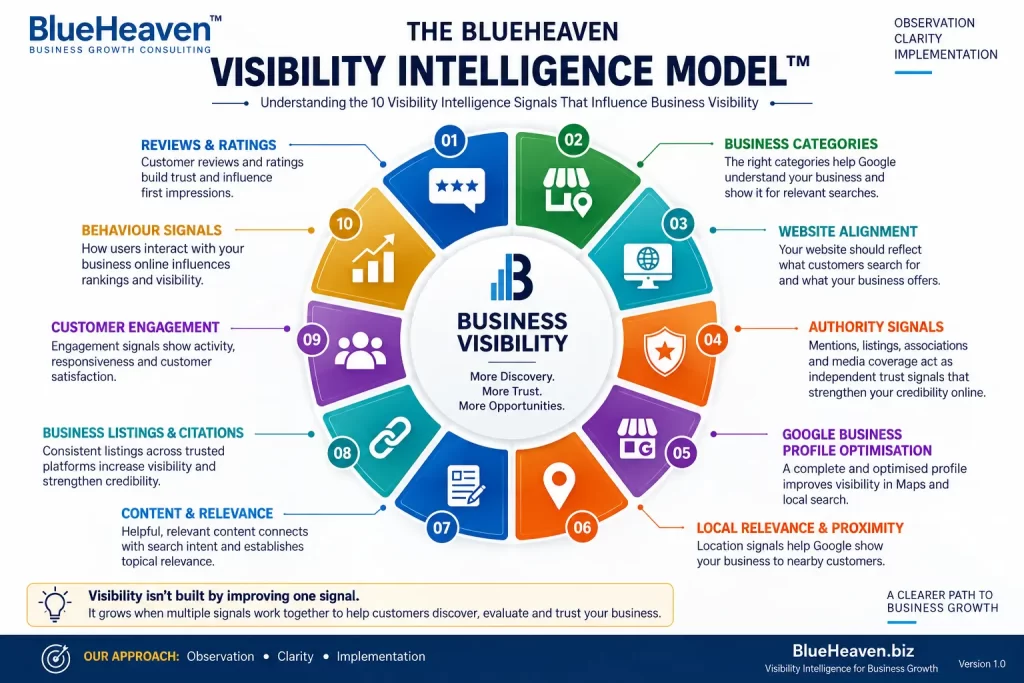
The relevant signals from the BlueHeaven Visibility Intelligence Model™ include:
03 — Website Alignment
Examines whether the website communicates the business’s identity, offerings and value proposition consistently.
04 — Authority Signals
Explores the external references, mentions and credibility indicators that may support the business’s reputation.
07 — Content Relevance
Examines whether available content addresses the information needs of the intended audience.
09 — Customer Engagement
Investigates how prospective customers can interact with the business and what evidence exists of those interactions.
10 — Behaviour Signals
Considers what customers actually do after discovering the business, where reliable first-party data is available.
These signals should not be treated as isolated scores.
Their relationships may reveal questions that an examination of individual metrics would miss.
Key Takeaway
A business may have an active LinkedIn presence, a detailed website and relevant technical content. But the presence of these individual assets does not automatically establish that they work together effectively.
For B2B businesses, visibility should be examined across the entire journey—from discovery and understanding to evaluation and engagement.
The important questions are:
-
Does the professional platform presence reinforce the website?
-
Does the content help prospective buyers make informed decisions?
-
Do credibility signals support the business’s expertise?
-
Can interested buyers move easily towards an enquiry?
-
Is there evidence of what happens after discovery?
Individual metrics provide observations. Connected visibility signals provide a broader perspective.
The objective of Visibility Intelligence™ is not simply to identify gaps, but to understand relationships, recognise opportunities and determine what deserves further investigation.
The BlueHeaven Visibility Intelligence Model™
Ten connected signals. One broader picture of business visibility.
Consultant’s Observation
An active LinkedIn presence is useful. A detailed website is valuable. Technical content can support buyer evaluation.
But the presence of these assets does not automatically mean that they work together effectively.
For a B2B business, the more important question is whether its online presence helps the right people move from discovering the company to understanding its capabilities, trusting its expertise and taking an appropriate next step.
That requires looking beyond individual platform metrics.
The objective is not to count digital assets. It is to understand how they work together.
What Comes Next?
Visibility Investigation™ #003 demonstrates how professional platform activity, website alignment, content relevance and customer engagement can raise interconnected questions about B2B visibility.
The next step is not automatically to recommend more posts, a website redesign or another marketing campaign.
It is to determine which observations deserve further investigation and what evidence is needed before deciding on action.
That is the purpose of Visibility Intelligence™.
About Visibility Investigations™
Visibility Investigations™ examine how effectively a business is being discovered, understood, trusted and engaged with, using relevant Visibility Intelligence signals and observable evidence to identify patterns, opportunities and areas that may deserve further investigation.
Each investigation explores a business situation through the BlueHeaven Visibility Intelligence Model™.
These investigations are intended to demonstrate an evidence-led approach to understanding business visibility. They are not automatically comprehensive audits or confirmed diagnoses of the businesses or situations discussed.
Want to Understand Your Business Visibility?
A Visibility Snapshot™ can provide a focused preliminary examination of selected visibility signals relevant to your business.
It helps identify meaningful observations, potential opportunities and questions that may deserve closer investigation.
Explore Visibility Intelligence & Business Growth Consulting — BlueHeaven.biz
Begin with Observation. Gain Clarity. Decide What to Implement.
#VisibilityIntelligence #BusinessGrowth #B2BMarketing #BusinessVisibility #VisibilityInvestigations #B2BVisibility #WebsiteStrategy #BusinessAnalysis #Consulting