
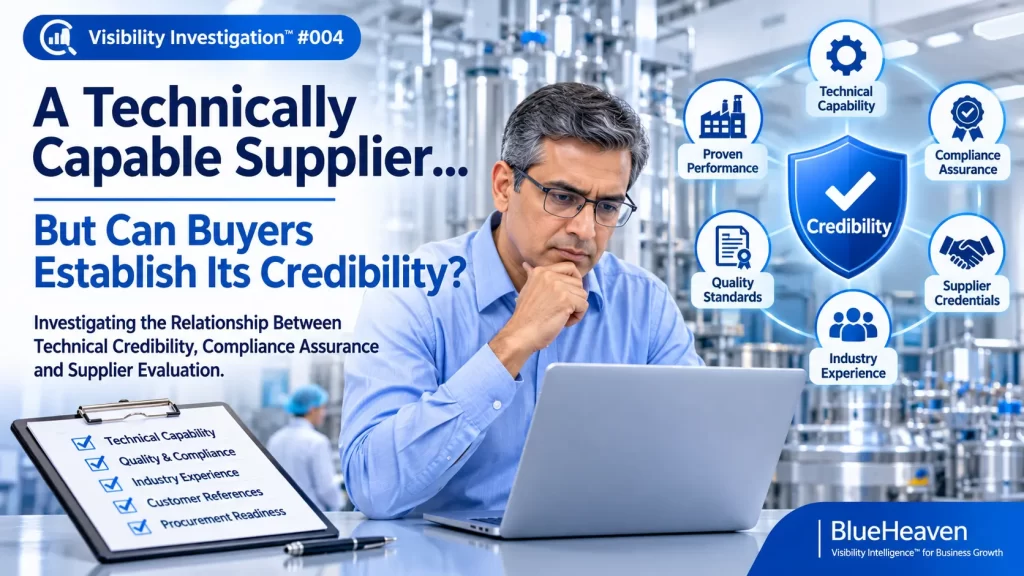
Investigating the Relationship Between Technical Credibility, Compliance Assurance and Supplier Evaluation
Introduction:
Being Capable and Being Considered Are Two Different Things
A pharmaceutical machinery manufacturer may have years of manufacturing experience, a technically capable product range and an established presence in the industry.
It may understand the requirements of pharmaceutical and API manufacturing environments. It may have relevant quality systems, technical documentation and experience supplying industrial equipment.
But there is another question worth examining:
Can a prospective pharmaceutical buyer establish the manufacturer’s credibility from the information available to them?
In the pharmaceutical industry, supplier evaluation can involve several considerations beyond product specifications and pricing.
Technical suitability, quality assurance, documentation, manufacturing capabilities, service support and relevant project experience may all influence how a potential supplier is evaluated.
A manufacturer may possess many of these capabilities. However, if they are not communicated clearly and supported by appropriate evidence, prospective buyers may find it difficult to assess the supplier.
This Visibility Investigation™ explores the relationship between a manufacturer’s actual capabilities, its online presentation and the information that prospective pharmaceutical buyers may need when evaluating a supplier.
The Business Situation
Consider an established manufacturer of pharmaceutical machinery and equipment serving the Indian pharmaceutical and API manufacturing sector.
The manufacturer has:
-
Experience in designing and manufacturing specialised machinery.
-
A product portfolio serving pharmaceutical manufacturing applications.
-
Technical personnel and manufacturing facilities.
-
Quality systems and relevant certifications.
-
Experience with customer projects and equipment installations.
-
A website and presence on professional and industry platforms.
On the surface, these appear to be valuable business assets.
However, a prospective buyer evaluating the manufacturer may have several questions:
-
Does the manufacturer understand the requirements of pharmaceutical manufacturing environments?
-
Can it demonstrate the technical suitability of its equipment?
-
What quality systems and documentation practices does it follow?
-
Does it have relevant experience with pharmaceutical or API manufacturers?
-
Can it provide appropriate technical and service support?
-
Is there sufficient information to consider the company for a supplier evaluation process?
These questions extend beyond whether the manufacturer has a website or appears in search results.
They concern the credibility that the business communicates to its intended market.
Initial Observations: What Can a Prospective Buyer Establish?
Suppose an initial review of the manufacturer’s publicly available information reveals the following observations.
| Area examined | Initial observation |
|---|---|
| Website presentation | Products and manufacturing capabilities are presented, but the depth of supporting information varies. |
| Technical information | Product descriptions and specifications are available, although application-related information may need closer examination. |
| Quality and compliance communication | Quality-related claims are visible, but the scope and supporting evidence require verification. |
| Industry experience | The business refers to its experience, but relevant project credentials and customer references are not consistently evident. |
| External credibility | Some industry references may be available, but their relevance and significance require examination. |
| Buyer engagement | Contact information is available, but the process for technical discussions and supplier enquiries deserves closer attention. |
These are illustrative observations, not findings from an actual manufacturer’s investigation.
They do not establish that the manufacturer lacks technical capability or that its quality systems are inadequate.
They provide a starting point for examining a more important question:
How effectively does the manufacturer’s online presence communicate the credibility it claims to possess?
Observation 1: Technical Capability Versus Communicated Capability
A machinery manufacturer may have considerable engineering experience and a product range designed for specific pharmaceutical manufacturing applications.
But how easily can a prospective buyer understand these capabilities?
Consider the information a technical or engineering decision-maker may want to examine:
-
Product specifications and technical parameters.
-
Intended applications and operating requirements.
-
Materials of construction, where relevant.
-
Equipment design considerations.
-
Available customisation and integration capabilities.
-
Installation, commissioning and after-sales support.
A product page that simply lists machinery models and general features may not answer all the questions a prospective buyer needs to consider.
Similarly, a technically capable manufacturer may have substantial application experience that is not adequately communicated through its website.
This brings Signal 03 — Website Alignment into focus.
The investigation should examine whether the website accurately and clearly communicates the manufacturer’s products, technical capabilities, intended applications and value proposition.
The question is not whether the manufacturer has published enough information.
It is whether the available information helps the intended buyer understand what the manufacturer can offer and where its capabilities may be relevant.
Observation 2: Compliance Assurance—Are the Claims Supported by Evidence?
For manufacturers supplying equipment to pharmaceutical and API manufacturing facilities, quality and compliance-related considerations can form an important part of supplier evaluation.
Buyers may need to understand how equipment design, manufacturing practices and supporting documentation relate to their own quality and manufacturing requirements.
Depending on the equipment and application, relevant considerations may include:
-
Quality management systems.
-
Material traceability.
-
Equipment design and construction.
-
Surface finish and material specifications, where applicable.
-
Cleaning and maintenance considerations.
-
Technical documentation.
-
Testing and inspection records.
-
Factory and site acceptance testing, where applicable.
-
Qualification and validation support, where required.
The manufacturer’s online presentation may refer to certifications, quality systems or compliance-related capabilities.
However, the presence of a claim does not independently establish its validity or scope.
A responsible investigation should ask:
-
Is the certification relevant to the manufacturer’s activities?
-
Is it current and independently verifiable?
-
Does the manufacturer explain the quality systems it follows?
-
Are compliance-related capabilities supported by appropriate documentation?
-
Are technical and regulatory claims expressed accurately?
It is also important to distinguish between regulatory requirements applicable to pharmaceutical manufacturing and the credentials of an equipment supplier.
For example, USFDA is a regulatory authority. US cGMP requirements and WHO-GMP guidance relate to pharmaceutical manufacturing practices. A machinery manufacturer should not automatically describe its equipment as USFDA-approved or WHO-GMP-certified merely because its products are intended for pharmaceutical applications.
The actual certification, documentation, design capability or compliance support must be established.
This investigation therefore examines how compliance-related credibility is communicated, not whether the manufacturer or its equipment is regulatorily compliant.
Observation 3: Industry Experience – Is There Evidence That Buyers Can Evaluate?
Experience is often an important part of a manufacturer’s positioning.
A company may state that it has supplied equipment to pharmaceutical manufacturers for many years.
But what does that experience communicate to a prospective buyer?
Consider the difference between these two statements:
Statement A:
“We have extensive experience in supplying pharmaceutical machinery.”
Statement B:
“We have experience in supplying equipment for specified pharmaceutical manufacturing applications, supported by relevant project references and documented technical capabilities.”
The second statement gives the buyer more meaningful information, provided the supporting evidence exists.
Relevant evidence may include:
-
Verifiable installations.
-
Project references, with customer permission.
-
Documented application experience.
-
Product-specific case examples.
-
Customer testimonials.
-
Evidence of service and support capabilities.
Not every customer or installation can necessarily be disclosed publicly. Commercial confidentiality may restrict what a manufacturer can publish.
However, the manufacturer should consider whether it can communicate relevant experience through appropriately approved references, anonymised project descriptions or other substantiated information.
This brings Signal 04 — Authority Signals into focus.
The objective is to understand whether the manufacturer’s reputation and technical experience are supported by credible evidence rather than relying solely on self-declared claims.
Observation 4: Supplier Credentials—Can the Manufacturer Demonstrate Procurement Readiness?
In institutional B2B procurement, being technically capable is not necessarily sufficient to become a considered supplier.
Large pharmaceutical companies, CDMOs and other manufacturing organisations may have their own vendor registration, supplier qualification, prequalification and procurement procedures.
Depending on the buyer and equipment category, these processes may examine:
-
Company and manufacturing credentials.
-
Quality management systems.
-
Technical capabilities.
-
Relevant experience.
-
Financial and commercial information.
-
Manufacturing and delivery capacity.
-
Documentation and service support.
-
References and past performance.
Approved Vendor Lists (AVL), vendor registration and Request for Proposal (RFP) processes may form part of this wider procurement environment.
For a machinery manufacturer seeking to enter the supply ecosystem of large pharmaceutical companies or CDMOs, these considerations can be commercially important.
But an important distinction must be maintained.
An online investigation cannot establish that a manufacturer is on a particular buyer’s Approved Vendor List simply because it claims to have supplied pharmaceutical companies.
Nor does vendor registration automatically guarantee an RFP invitation or an order.
The investigation should instead examine what can be established:
-
Does the manufacturer communicate relevant institutional supply experience?
-
Are supplier credentials or approved vendor relationships publicly disclosed and verifiable?
-
Does it demonstrate familiarity with formal supplier evaluation requirements?
-
Is its technical and commercial information organised to support buyer evaluation?
-
Can it provide relevant documentation and references when requested?
Where AVL status or procurement eligibility is not publicly verifiable, it must be recorded as requiring confirmation.
This is an important distinction between visible supplier credibility and actual procurement qualification.
Observation 5: Does the Online Presence Support Buyer Evaluation?
Even when a manufacturer has relevant technical capabilities and experience, prospective buyers need to find and understand the information.
Consider the journey of a procurement or engineering professional who discovers the manufacturer through an industry reference, LinkedIn or a search engine.
The buyer may visit the website to examine its product range, technical capabilities, quality credentials and relevant experience.
Does the website make this information easy to locate?
Can the buyer identify the appropriate contact person?
Is there a clear route to request technical specifications, discuss an application or initiate a commercial enquiry?
Are the company’s LinkedIn presence and other relevant industry references consistent with the information presented on its website?
These questions connect several visibility signals:
-
03 — Website Alignment: Does the website present the manufacturer’s capabilities consistently?
-
07 — Content Relevance: Does the content address the technical and business questions buyers may have?
-
08 — Listings & Citations: Is the business represented accurately across relevant external platforms and references?
-
09 — Customer Engagement: Can interested buyers initiate meaningful discussions?
The individual assets may all exist.
But their combined contribution to buyer understanding and evaluation deserves examination.
Looking at the Connections Between Signals
The observations become more meaningful when examined together.
| Connected signals | Question worth investigating |
|---|---|
| Website Alignment + Content Relevance | Does the website communicate technical capabilities in a way that helps buyers evaluate suitability? |
| Authority Signals + Content Relevance | Does the published information support the manufacturer’s claims of experience and expertise? |
| Authority Signals + Listings & Citations | Are relevant external references consistent with the manufacturer’s stated credentials? |
| Authority Signals + Customer Engagement | Can buyers obtain the supporting information needed to evaluate the supplier? |
| Website Alignment + Customer Engagement | Does the website provide a clear route from product evaluation to a technical or commercial discussion? |
This is where connected visibility signals become important.
A manufacturer may possess technical experience, relevant quality credentials and an established product portfolio.
Yet the way these elements are presented may leave prospective buyers with unanswered questions.
Conversely, a manufacturer may already communicate its capabilities effectively, even if every detail is not publicly available.
The investigation should examine the evidence rather than presume a problem.
What Cannot Be Established From Public Information Alone?
A responsible investigation must recognise its limitations.
Without appropriate documentation, direct verification or access to internal records, the following cannot reliably be established:
-
Whether a manufacturer’s quality certifications are valid and applicable.
-
Whether its equipment meets a particular customer’s technical requirements.
-
Whether its documentation is sufficient for a specific qualification or validation exercise.
-
Whether it is included in a particular pharmaceutical company’s AVL.
-
Whether it has been invited to specific RFPs.
-
Whether its past projects demonstrate the required performance.
-
Whether prospective buyers have rejected the supplier because of perceived credibility gaps.
These matters may require certification records, technical documentation, customer references, procurement information or specialist assessment.
Publicly available information can help identify questions worth investigating. It cannot replace technical, regulatory or procurement verification.
The Visibility Intelligence Perspective
This investigation illustrates why supplier credibility should not be examined through a single website page, certification claim or customer testimonial.
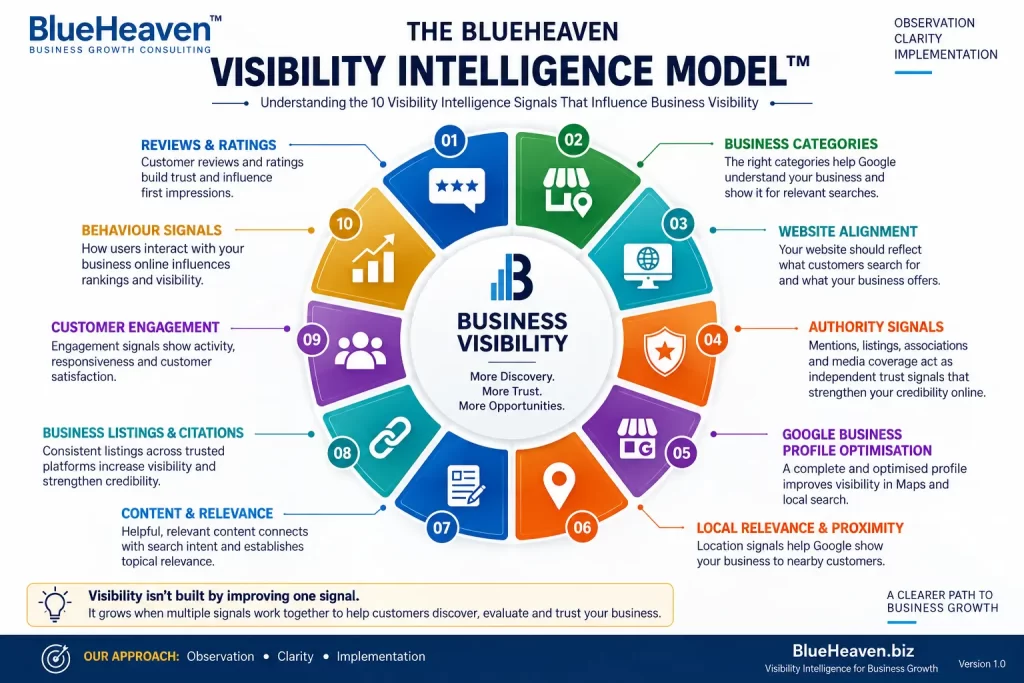
The relevant signals from the BlueHeaven Visibility Intelligence Model™ include:
03 — Website Alignment
Examines whether the website communicates the manufacturer’s identity, products, capabilities and applications clearly and consistently.
04 — Authority Signals
Investigates the evidence supporting technical credibility, industry experience, regulatory and compliance assurance, customer confidence and supplier qualification credentials.
07 — Content Relevance
Examines whether the available content addresses the information needs of prospective pharmaceutical buyers.
08 — Listings & Citations
Considers the manufacturer’s representation across relevant directories, industry listings and external references.
09 — Customer Engagement
Examines whether prospective buyers can readily access relevant information and initiate appropriate discussions.
These signals are interconnected.
A manufacturer may have genuine technical capabilities and relevant experience, but prospective buyers still need sufficient information to understand and evaluate those capabilities.
The objective is not to assign an arbitrary score to each signal.
It is to identify meaningful observations, understand their relationships and determine which questions deserve further investigation.
Key Takeaway
Possessing credibility and communicating credibility are two different things.
A pharmaceutical machinery manufacturer may have technical expertise, quality systems, relevant installations and experience serving the industry.
But prospective buyers need to understand what the manufacturer can offer, what evidence supports its claims and how its capabilities relate to their requirements.
For businesses operating in technical, relationship-driven and compliance-conscious markets, credibility is not established merely by making claims.
It needs to be communicated clearly and supported by appropriate evidence.
The purpose of Visibility Intelligence™ is to examine how effectively that credibility is being presented and what the connected signals reveal about the buyer’s ability to evaluate the business.
The BlueHeaven Visibility Intelligence Model™
The ten signals provide a structured framework for investigating how effectively a business is being discovered, understood, trusted and engaged with online.
Consultant’s Observation
In pharmaceutical and industrial B2B markets, a manufacturer’s credibility can influence whether it receives serious consideration from prospective buyers.
However, technical capability, compliance assurance and procurement eligibility are not marketing claims to be invented or exaggerated.
They must be established through appropriate evidence and, where necessary, verified by qualified specialists.
The role of marketing and business growth strategy is to ensure that genuine capabilities, relevant experience and supporting credentials are communicated effectively to the intended market.
A manufacturer should not merely tell buyers that it is capable. It should make it easier for buyers to understand and evaluate why it is worth considering.
What Comes Next?
Visibility Investigation™ #004 demonstrates how technical credibility, compliance assurance, supplier credentials and online presentation can raise interconnected questions about B2B supplier visibility.
The next step is not automatically to recommend a website redesign, more content or another marketing campaign.
It is to determine which observations deserve further investigation and what evidence is needed before deciding on action.
That is the purpose of Visibility Intelligence™.
About Visibility Investigations™
Visibility Investigations™ examine how effectively a business is being discovered, understood, trusted and engaged with, using relevant Visibility Intelligence signals and observable evidence to identify patterns, opportunities and areas that may deserve further investigation.
Each investigation explores a business situation through the BlueHeaven Visibility Intelligence Model™.
These investigations are intended to demonstrate an evidence-led approach to understanding business visibility. They are not automatically comprehensive audits or confirmed diagnoses of the businesses or situations discussed.
Want to Understand Your Business Visibility?
A Visibility Snapshot™ can provide a focused preliminary examination of selected visibility signals relevant to your business.
It helps identify meaningful observations, potential opportunities and questions that may deserve closer investigation.
Begin with Observation. Gain Clarity. Decide What to Implement.
Explore Visibility Intelligence & Business Growth Consulting at BlueHeaven.biz.